Why Rooftop Solar is Perfect for Indian Warehouses
Rooftop solar for warehouses india: engineer PEB metal roofs with wind zoning and penetration-free clamps to cut bills, protect roofs.

Yash Jakhete
Co-Founder
Why Rooftop Solar is Perfect for Indian Warehouses
Warehouses are one of the easiest building types in India to justify rooftop solar panels, especially with the increasing adoption of rooftop solar for warehouses in India. The reasons are simple: large roof plates, predictable daytime electricity use (lighting, material handling, HVAC, cold storage), and a tariff profile where every unit you generate on-site can replace a relatively expensive grid unit.
Yet warehouse roofs are not all the same. A big share of modern industrial sheds use PEB roofs (pre-engineered buildings) with profiled metal sheets over steel purlins. This changes how solar should be mounted, how wind uplift is handled, and how to keep the roof warranty and waterproofing intact for decades.
Why PEB warehouse roofs need a different solar approach
A PEB roof is lightweight by design. The steel sheet is thin, the purlins are spaced for economy, and the roof slope is usually low to moderate to drain rain quickly. All of that is great for construction speed, but it means solar design cannot be “standard terrace solar with a generic structure”.
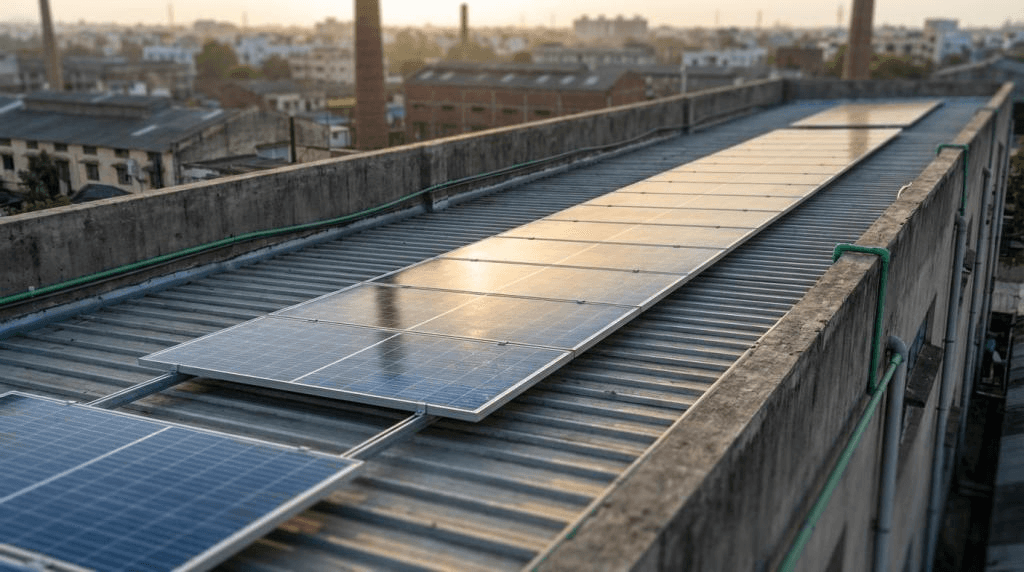
In India, warehouses are often located in open industrial belts, logistics parks, or on the outskirts of cities. The roof is exposed, making it an ideal candidate for the installation of solar panels to optimize energy utilization. Wind behaviour at corners and edges becomes a major driver of mounting selection, clamp spacing, and module layout.
The good news is that when engineering is done properly, PEB rooftops are very solar-friendly and can deliver strong ROI without turning the roof into a maintenance liability, especially when utilizing renewable energy sources such as solar power and achieving significant energy savings.
Penetration-free mounting: what it means on metal roofs
“Penetration-free” on a warehouse usually means you avoid drilling through the roofing sheet for module mounting. The core objective is to reduce leak risk and preserve the roof’s weather-tightness.
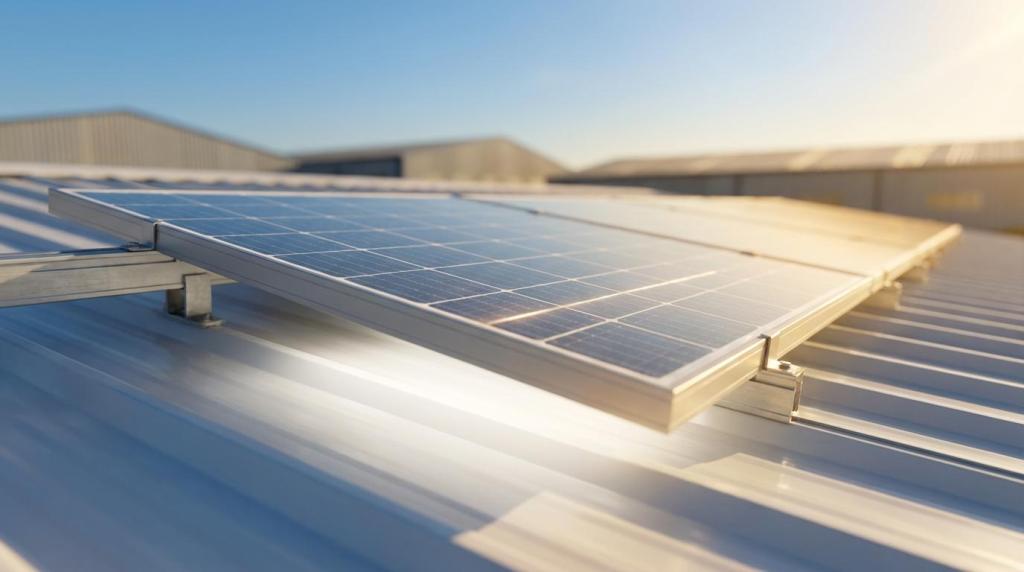
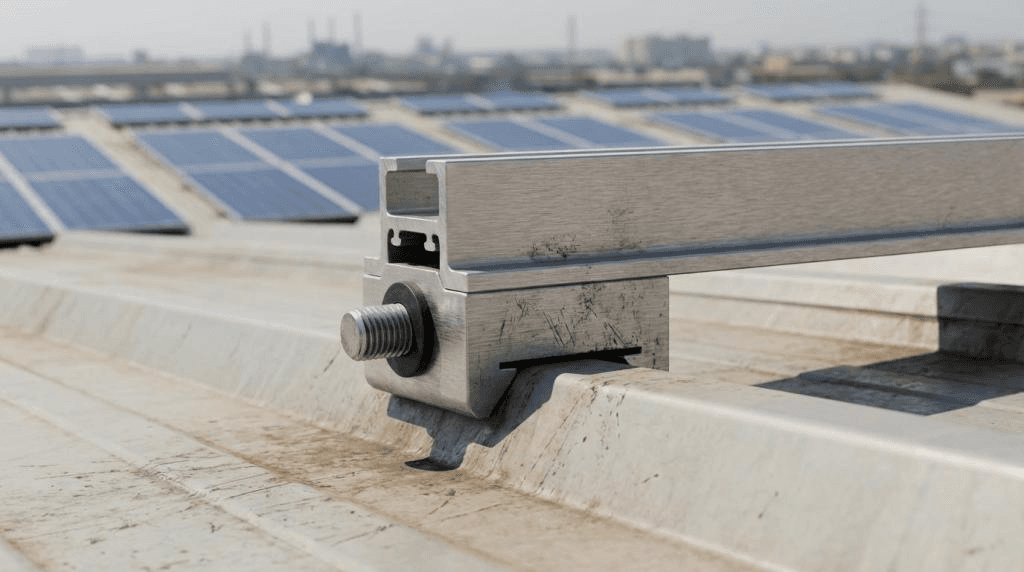
On profiled metal sheets (common PEB trapezoidal profiles and standing seam roofs), penetration-free mounting is typically achieved through clamps that grip the seam or rib. These transfer loads to the sheet profile and, through it, to the purlins, when designed correctly.
This is different from flat RCC roofs where you might use chemical anchors, or membrane roofs where you may use ballast trays.
Choosing the right mounting type for a warehouse
Selection is not only about “no holes”. It is about wind, roof slope, sheet profile, corrosion environment, and how the warehouse team wants to access the roof for cleaning and inspections.
Mounting approach | Best suited for | Key advantage | Main trade-off to manage |
|---|---|---|---|
Seam or rib clamping (non-penetrating) | PEB metal roofs with ribs/standing seams | Low leak risk; lightweight; fast install | Needs profile-specific clamps and correct torque; wind zoning is critical |
Ballasted systems (weight-based) | Flat or very low-slope roofs with sufficient structural reserve | No attachments to roof; no clamp-profile dependency | Adds significant dead load; wind design can demand heavy ballast |
Hybrid (limited attachments + aero features) | Sites with high wind demand and low roof load margin | Controls uplift without excessive ballast | More engineering and detailing; not “one size fits all” |
A penetration-free plan can still include a small number of sealed service penetrations for DC/AC routing, earthing conductors, and monitoring cables. The difference is that the mounting itself does not become a leak pathway repeated hundreds of times.
Wind loads: the make-or-break factor on warehouse rooftops
Warehouses behave like large wind collectors. In practical terms, the riskiest zones are:
roof corners
roof edges (perimeter bands)
near step-ups, parapets, or changes in roof height
A well-designed system treats the roof in zones and applies higher design loads at corners and edges than in the interior. This usually leads to closer clamp spacing, stronger rails, and sometimes different module orientation near the perimeter.
Indian projects typically follow relevant provisions from IS codes (wind actions and structural design) along with manufacturer-rated mounting components and project-specific structural sign-off. What matters on-site is not the paperwork, but whether the design accounts for the true exposure category: open terrain, nearby tall buildings, coastal gusts, and height of the shed.
One more point: tilt increases wind demand. If your warehouse roof already has a slope, flush or low-profile mounting often wins on both wind resistance and simplicity.
Structural reality check: load paths on a PEB roof
Solar loads on a metal roof are not just “panel weight”. The roof must handle:
dead load of modules, rails, clamps
maintenance loads (people on the roof)
wind uplift and suction
thermal movement cycles
The load path should be clear: module to rail to clamp to roof profile to purlin to main frame. If the clamp is gripping a thin sheet rib without the support of a purlin beneath, you may end up with sheet deformation even if nothing “fails” immediately.
A proper assessment usually checks purlin spacing, purlin section capacity, rafter/truss reserve, and connection adequacy. On older sheds, corrosion, prior leak repairs, and sheet replacement history matter as much as design drawings.
Thermal expansion and corrosion: the long-life details people skip
PEB roofs in Maharashtra and much of India see high surface temperatures. Metal expands and contracts daily; aluminum rails do too, often at a different rate. A good mounting design allows controlled movement without loosening hardware over time.
Corrosion is another slow risk. Many warehouses are near humid zones, chemical storage, or coastal influence. Hardware choice matters: fasteners, rail finish, and isolation washers to avoid galvanic corrosion between dissimilar metals.
Small choices add up over a 25-year asset life. The ROI of solar panels in renewable energy systems looks best when the roof stays dry and the structure stays stable without recurring rework.
Layout choices that improve energy yield and operations
Warehouses often have rooftop elements that create shadow and access constraints: solar panels, skylights, turbo vents, ridge ventilators, HVAC units, fire systems, and lightning protection conductors. Good layouts treat these as design inputs, not last-minute obstacles.
A practical layout aims for:
clear maintenance corridors for safe movement
safe distance from roof edges and fragile skylights
string design that avoids mismatch losses from partial shading
room for future capacity expansion if the electrical connection allows it
In many warehouses, solar also reduces heat gain through roof shading, contributing to energy savings. That can lower the load on ventilation and cooling, which is a secondary financial benefit that facility teams notice quickly during summer.
Commercial decisions: CAPEX vs OPEX for warehouse solar in India
Warehouse owners in India usually evaluate rooftop solar for warehouses in India on payback, IRR, and operational certainty. Two common structures are:
CAPEX: you invest upfront and own the plant
OPEX/PPA: a third party invests; you pay per unit at an agreed tariff for a fixed tenure, often with O&M included
For facilities that prefer predictable cashflows, OPEX can be attractive if the tariff discount is meaningful versus the grid and the contract terms are clear about performance, shutdowns, and responsibilities.
When net metering is available and approved, exports can improve savings, but many warehouses already have strong daytime consumption, so self-consumption alone can deliver healthy returns.
Approvals and net metering in Maharashtra: what typically decides timelines
In Maharashtra, the commercial viability of warehouse rooftop solar often depends on how smoothly approvals and commissioning move with the DISCOM and related stakeholders. Delays are usually caused by documentation gaps, single-line diagram mismatches, meter-related readiness, or site conditions that do not match the application.
A disciplined pre-check reduces back-and-forth. Before you freeze system size, it helps to have clarity on contract demand, transformer capacity, existing power quality issues, and how the export cap may be applied (if applicable).
Solarising generally supports organisations across this end-to-end flow, including feasibility, system engineering, approvals, installation, and long-term O&M, with a strong focus on Maharashtra-specific execution and ROI-driven sizing.
What data you should collect before asking for a proposal
Most proposal variations happen because the site inputs are incomplete. A quick internal data pack speeds up accurate design and pricing.
Sanctioned load and contract demand: latest bill snapshot and connection details
Roof details: profile type, sheet thickness (if known), purlin spacing, roof age, warranty status
Operating pattern: working days, shift timings, major loads (HVAC, refrigeration, process)
Constraints: skylights, vents, fire access lanes, no-go zones, future rooftop plans
Common mistakes seen on warehouse solar projects
Even good equipment can underperform if basics are missed. These are frequent failure points on metal-roof warehouses:
Ignoring wind zones: treating corners like interior rows and using uniform clamp spacing
Wrong clamp selection: mismatch with roof profile leading to slippage or sheet damage
No access planning: arrays packed wall-to-wall with no safe walkway for cleaning and inspection
Cable routing shortcuts: UV exposure, sharp edges on metal, or water paths created by poor conduit placement
O&M on warehouse rooftops: keeping performance and roof health stable
A warehouse system should be maintained like a production asset, not like a one-time construction job. Cleaning frequency depends on dust levels and rainfall patterns. Many industrial belts in Maharashtra need more frequent cleaning in dry months due to dust from traffic and nearby plots.
Inspection is equally important. Clamp torque checks, corrosion inspection, and checking for any module movement after strong wind events can prevent small issues from becoming downtime.
If you are running a logistics operation, downtime has an opportunity cost. It is sensible to treat monitoring and service response times as part of the commercial evaluation, not an afterthought.
Questions to ask your EPC before you sign off
A warehouse rooftop is a high-value surface for implementing rooftop solar for warehouses in India. Asking the right questions protects both ROI and roof integrity.
Structural sign-off scope: who is responsible for verifying purlins, connections, and load margins
Mounting warranty terms: what is covered for clamps, rails, corrosion, and long-term tightness
Performance and monitoring: what data you will receive and how faults are handled
Roof protection plan: walkways, skylight protection, water drainage paths, and safe access provisions
Getting from idea to commissioning without disrupting warehouse operations
Most warehouses cannot afford long shutdowns or safety incidents. A sensible execution plan sequences the work: material staging, roof access control, installation blocks, electrical integration, and testing.
If you plan it well, rooftop solar becomes one of the few infrastructure upgrades that can be completed with minimal operational disruption while cutting unit energy costs for decades.
Share on social media