Top Factors Influencing Rooftop Solar ROI for SMEs in India
Rooftop solar ROI factors India: tariff structure, daytime self-use, shading, correct sizing, approvals speed, and O&M discipline.

Yash Jakhete
Co-Founder
Top Factors Influencing Rooftop Solar ROI for SMEs in India
Rooftop solar has become one of the most straightforward ways for Indian SMEs to reduce electricity costs through renewable energy, yet payback timelines and return on investment factors in India can swing widely from site to site. Two factories with the same sanctioned load can see very different ROI because solar returns are shaped by tariffs, operating hours, roof constraints, approvals, solar panel financing options, and how the system is sized and maintained.
If you are evaluating rooftop solar in Maharashtra, it helps to treat ROI as an engineering and billing problem, not a generic “per kW” quote.
The payback equation (and what actually changes it)
At its simplest, rooftop solar payback is driven by annual savings minus annual costs, divided into the upfront investment, highlighting the installation benefits of reduced electricity costs and a greener energy footprint.
A one-line mental model:
Payback (years) = Total project cost ÷ (Annual bill savings minus annual O&M and finance costs)
One sentence that often saves time: the fastest ROI comes from maximising self-consumption of solar units and offsetting the highest-cost parts of your bill.
Factor 1: Your electricity tariff, not just your monthly bill
Many SME decisions start with “we pay ₹X per month”, but ROI needs the tariff structure. In Maharashtra (and across India), the effective rate can change with:
Energy charges (₹/kWh)
Demand charges (₹/kVA or ₹/kW)
Time-of-Day (ToD) rates for certain categories
Wheeling, FAC and other components depending on connection type and DISCOM
Solar primarily reduces energy charges. Demand charges reduce only in limited cases and usually need deliberate design and operational changes.
A practical check is to compute your “blended” rate: total bill divided by total units. Then compute the “avoidable” rate: the part of the bill that solar will actually offset per unit. That avoidable rate is what drives savings.
Factor 2: Operating hours and self-consumption percentage
The same rooftop plant gives very different savings depending on when you use power. Solar generation is concentrated in daytime, so businesses that run day shifts (or have daytime process loads like compressors, HVAC, machining, cold rooms, IT loads) tend to see quicker payback.
A site with high daytime consumption can self-consume most solar panels units and save at the full avoidable rate. A site that runs mainly at night will export more and rely on net metering credits, which may extend the payback period depending on rules and consumption patterns.
After checking 12 months of bills, a quick operational map helps:
What equipment runs between 10 am and 4 pm?
Are there seasonal shutdowns that reduce daytime loads?
Can any flexible loads (water pumping, pre-cooling, air compression) be scheduled during solar hours?
Small schedule changes can move ROI meaningfully, especially for SMEs where the solar plant size is close to daytime base load.
Factor 3: Roof area, shade, and structural readiness
Rooftop solar ROI is not only financial. Physical constraints decide how many “good” units the plant will generate.
Key ROI impacts come from:
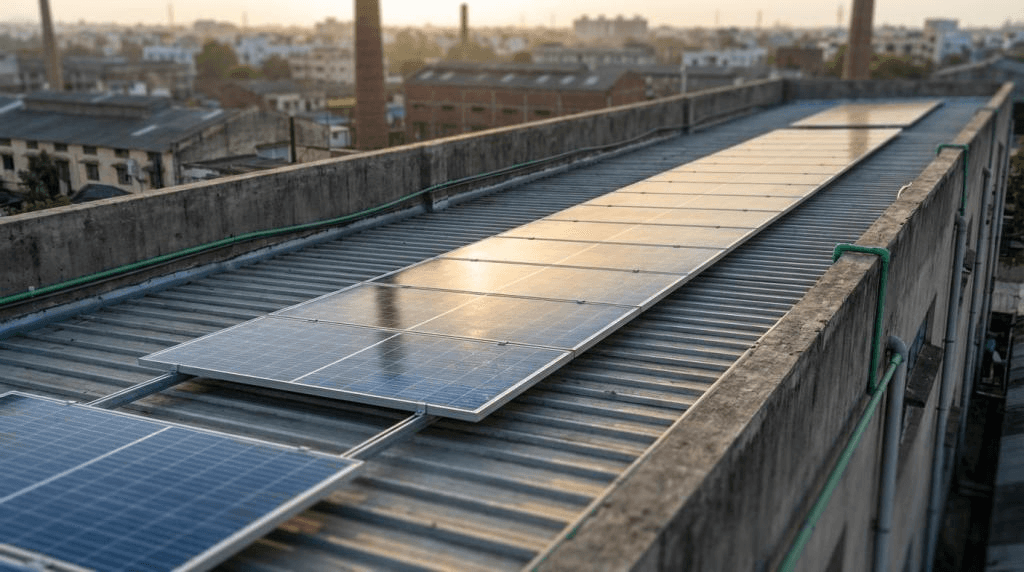
Shade from parapet walls, overhead tanks, stair cabins, nearby buildings, trees
Roof orientation and tilt options
Waterproofing condition and future roof work plans
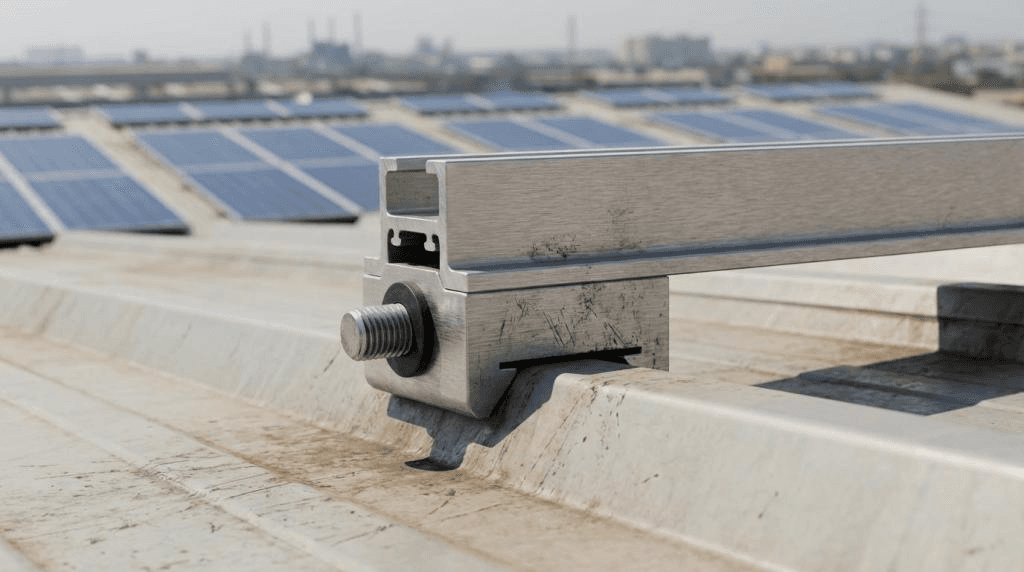
Structural capacity and mounting approach (including wind load considerations in many parts of Maharashtra)
Shade is a silent ROI killer because it reduces generation and can affect string performance if not designed carefully. Even partial shading on a few modules can drag the output of a larger section if the electrical design is not planned well.
A single sentence worth repeating: a smaller unshaded plant can outperform a larger shaded plant over the year.
Factor 4: System size vs sanctioned load vs export limits
Many SMEs ask for “as much as possible” on the roof. A better approach is “as much as you can use”.
Sizing should account for:
Daytime base load and peak load
Holiday and seasonal patterns
Net metering and export rules applicable to your DISCOM
Available roof area for installing solar panels after leaving maintenance walkways and safety setbacks
Oversizing can lead to frequent exports that do not get fully adjusted due to billing cycles, minimum charges, or low consumption in certain months, impacting electricity costs. Undersizing leaves savings on the table. The right size usually sits close to the daytime consumption curve, not just roof capacity.
A good feasibility study will show month-wise expected generation and month-wise offset against your bill, not only an annual number.
Factor 5: Net metering process and timeline in Maharashtra
In Maharashtra, the return on investment (ROI) clock and payback period often start ticking only after approvals, meter replacement, and commissioning. Delays can add weeks or months, which affects real payback even if the “paper ROI” looks attractive.
Net metering specifics vary by DISCOM and consumer category, so it is useful to treat approvals as a project task, not a formality. If your rooftop solar partner handles drawings, applications, follow-ups and meter coordination, your plant starts saving earlier.
From an ROI angle, the approval timeline affects solar panel financing options:
Interest during construction if you are financing
Lost generation during high-sun months if commissioning slips
Internal confidence when management expects savings to start by a certain date
Solarising, as an EPC focused on Maharashtra, typically plans the approvals workflow alongside engineering so the paperwork does not become a surprise dependency later.
Factor 6: Capex vs loan vs OPEX (PPA) and what ROI really means for your business
“Payback period” is often used loosely. For an SME, there are at least three different decision frames:
Capex purchase: You invest upfront and keep the full savings after O&M costs. ROI is usually highest here if you have capital and a long-term view.
Loan/finance: You preserve cash, but EMI reduces near-term net savings. Payback should be viewed as “equity payback” and “project payback” separately.
OPEX or PPA model: You pay per unit for solar energy at an agreed rate for a fixed tenure with zero upfront investment (depending on the offer). Your “ROI” is immediate monthly savings rather than asset payback.
A useful way to choose is to match the model to your balance sheet priorities: cash conservation, risk tolerance, and how comfortable you are owning and maintaining an asset for 25 years.
Before selecting a model, clarify these commercial items in writing:
Tariff in PPA: per unit solar rate and escalation (if any)
Performance and uptime: who is responsible for shortfalls and how they are measured
Inclusions: net meter, monitoring, O&M scope, insurance (if offered)
Factor 7: Equipment quality, design choices, and generation confidence
Two systems of the same kW size can produce different units over the year, highlighting the installation benefits in terms of customized performance optimization. This shows up directly in rooftop solar ROI factors in India because savings are proportional to generation.
The design and quality elements that typically matter for SMEs:
Module and inverter selection appropriate to heat and dust conditions
DC to AC ratio chosen to maximise annual yield within inverter limits
Proper cable sizing, earthing, lightning protection, and protection devices
Layout that avoids inter-row shading and allows cleaning access
Monitoring that alerts you when generation drops
If you only compare quotes on ₹/kW, you may miss yield and uptime differences that outweigh small price gaps over time.
Factor 8: O&M discipline and cleaning frequency
Rooftop solar, a form of renewable energy, is low-maintenance, not no-maintenance. In many industrial and semi-urban areas of Maharashtra, dust loading can reduce output if cleaning is irregular.
O&M influences ROI through:
Generation loss due to soiling
Downtime from tripped inverters, damaged connectors, or water ingress
Slow detection of faults without monitoring
Safety risks that can stop operations if not addressed promptly
A practical KPI for SMEs is “units generated per kW per day” compared month-on-month. If it drops unusually, you can investigate quickly instead of losing savings for weeks.
After a site walkthrough, a simple O&M plan should answer:
Who cleans and how often?
Who responds to alarms, and in what time?
What is included in preventive visits?
What parts are covered and what is chargeable?
Factor 9: Taxes, depreciation, and accounting treatment
For many businesses in India, understanding rooftop solar ROI factors is crucial, especially post-tax ROI.
Depending on your entity type and tax position, rooftop solar may offer benefits through depreciation and expense treatment of O&M and interest. The exact impact varies by your accounting approach and applicable tax rules, so it is wise to validate with your CA using your project cost and expected savings schedule.
Even without getting into complex tax planning, ask for a cashflow view that separates:
Pre-tax savings
Post-tax impact (based on your assumptions)
Non-cash accounting benefits (where applicable)
A quick ROI diagnostic table (use this before you approve a quote)
ROI factor | What to check on your site/bill | Typical impact on payback | Practical action |
|---|---|---|---|
Tariff structure | Avoidable ₹/unit after fixed and demand components | High | Calculate avoidable rate from 12-month bills |
Daytime consumption | Base load between 10 am and 4 pm | High | Shift flexible loads to solar hours where possible |
Shadow-free roof | Shade map by hour, obstructions, future construction | High | Redesign layout, use better string planning, avoid shaded zones |
System sizing | Match plant size to daytime load and net metering rules | Medium to high | Do month-wise offset simulation, not only annual |
Approval timeline | DISCOM process steps and meter change lead time | Medium | Plan approvals early with complete documentation |
Financing terms | Interest rate, tenure, processing fees | Medium | Compare EMI vs savings month-wise |
O&M plan | Cleaning, monitoring, response time | Medium | Include monitoring and defined maintenance cadence |
Equipment and workmanship | BOS quality, protections, installation standards | Medium | Prefer bankable components and documented QA checks |
What usually speeds up ROI for SMEs (without cutting corners)
ROI improvements often come from small, practical decisions rather than aggressive assumptions. Common moves that help:
Short phrase wins: Reduce shade, keep strings balanced, maintain clean modules.
Bill-led sizing: size for self-use first, export second.
Approval readiness: keep ownership documents, sanction load details, and roof permissions ready.
Operations tweak: schedule one or two flexible loads in peak solar hours.
Monitoring discipline: catch underperformance early instead of at the end of the quarter.
Getting to a realistic payback number for your own rooftop
If you want a payback estimate you can take to management, avoid single-number promises. Ask for a simple pack of outputs based on your last 12 months of bills:
Expected generation month-wise (kWh)
Expected self-consumption vs export month-wise
Bill offset calculation month-wise using your tariff components
Capex and O&M, or PPA rate and contract assumptions
Sensitivity: what happens if generation is 5 percent lower, or if load reduces in off-season?
Solarising projects in Maharashtra are typically evaluated this way because it reduces surprises after commissioning. When the estimate is grounded in your billing data, roof reality, and the approvals pathway, the ROI discussion becomes clearer and faster to sign off.
The next step is simple: collect 12 electricity bills, a roof layout or drone photo if available, and a brief note on operating hours. A good feasibility study can then tell you not only “how many kW”, but also what will speed up your payback period on your specific site.
Share on social media