Rooftop Solar for Indian Factories: Boosting Energy Efficiency
Rooftop solar for factories India cuts daytime power bills 40–60%, delivers 3–5 year payback, with right sizing, O&M and approvals.

Yash Jakhete
Co-Founder
Rooftop Solar for Indian Factories: Boosting Energy Efficiency
Electricity is one of the most controllable costs in a factory, yet it often behaves like a moving target. Tariff revisions, demand charges, fuel adjustment costs, and seasonal production swings can make monthly bills unpredictable.
Rooftop solar for factories in India changes that equation by locking in a portion of your renewable energy at a stable, low lifetime cost. For many factories in India, especially those with strong daytime loads, it is less about “going green” and more about improving margins with a long-life asset.
What rooftop solar can realistically do for a factory
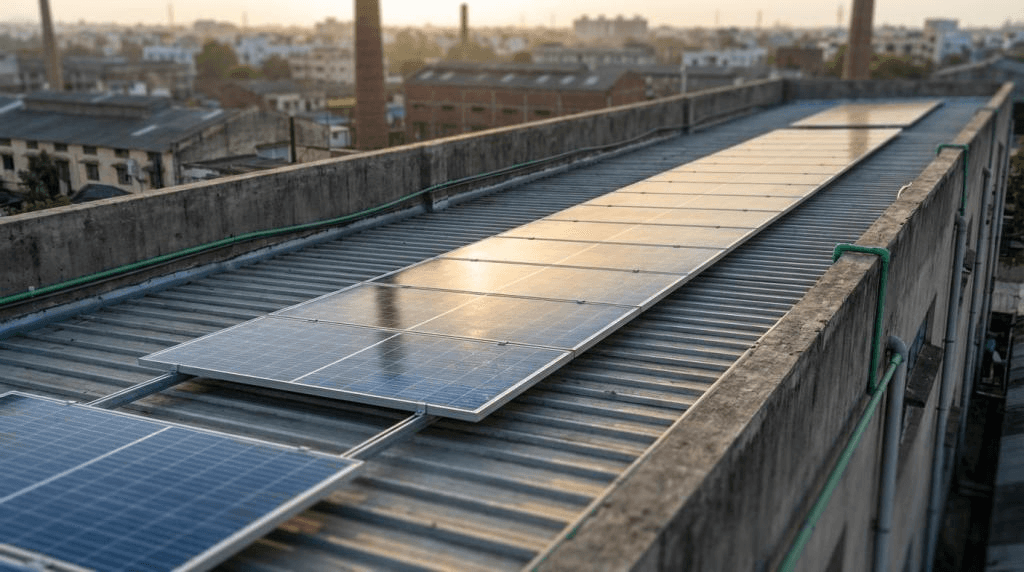
A grid-connected rooftop solar plant generates power during the day and supplies it directly to your internal loads. If generation is higher than your instant consumption, the surplus can be exported to the grid under net metering or net billing, depending on your DISCOM rules and sanction limits.
Most industrial rooftops target one clear outcome: reduce the number of paid units on the HT or LT bill. Industry references often cite 40 to 60% reduction in electricity cost for a well-designed industrial rooftop solar system, driven by improved energy efficiency, and payback commonly lands in the 3 to 5 year range when tariffs are favourable and the roof is suitable.
Solar does not replace your entire power requirement unless you pair it with storage or alternate arrangements. It replaces the most expensive part of your consumption: high-tariff daytime units.
The business case: savings, payback, and what drives ROI
Your ROI depends less on “solar is cheap” and more on the match between your load curve and solar generation.
Key drivers include your effective tariff (₹/kWh), your contracted demand and penalties, the usable shadow-free area, and how smoothly approvals and commissioning happen. If your factory operates one or two shifts with strong daytime consumption, rooftop solar generally offsets a large chunk of billed energy without creating frequent exports.
A quick way to think about the economics:
If your average landed tariff is higher, each solar unit replaces a costly grid unit.
If your plant often runs below peak demand during the day, solar can cover base load cleanly.
If you export too much, the credit value and settlement rules matter a lot.
Many factories also value the hedge effect. Once installed, solar generation is not exposed to fuel price shocks. Your O&M cost exists, but it is small compared to purchased power over 25 years.
Sizing rooftop solar for factories: start with load profile, not roof area
Factories sometimes begin with “how many kW can fit on the roof?” A better starting point is “how much daytime energy do we consistently use?” to ensure a good return on investment.
A design that overshoots consumption can still work, but it increases your dependence on export credits and DISCOM settlement policies. A right-sized system aims to maximise self-consumption.
After you review 12 months of bills and interval data (if available), sizing becomes a structured exercise:
Daytime base load: the minimum load your plant draws between roughly 9 am and 5 pm
Production seasonality: peak season vs lean months
Holiday patterns: weekly shutdowns can increase exports unless the system is limited or managed
Practical thumb rules (useful early, refined later)
The table below helps with quick internal discussions before a detailed engineering study.
Item | Quick reference range for factories (India) | Why it matters |
|---|---|---|
Usable roof area needed | ~8 to 10 m² per kW | Determines the upper cap of plant size |
Annual generation | ~1,200 to 1,500 kWh per kW per year | Varies by city, tilt, shading, heat |
CO₂ avoided | ~0.7 to 0.9 kg per kWh generated | Helps with ESG reporting and customer audits |
Panel loading | ~15 to 20 kg per m² including structure | Drives structural checks and mounting choice |
Typical payback | ~3 to 5 years (site-dependent) | Mainly driven by tariff and self-consumption |
These are directional numbers. Final outcomes depend on shading, roof type, module efficiency, inverter selection, and grid approval conditions.
Site feasibility for factories: what actually gets checked
A proper survey is not a formality. It decides whether your system performs as promised, and whether it remains safe through monsoons and high winds.
The survey usually covers roof condition, structural capacity, waterproofing status, and obstruction mapping (vents, skylights, HVAC units, cranes, cable trays). Shade analysis is critical because partial shading can pull down generation disproportionately, especially if strings are not designed correctly.
After a feasibility walkthrough, a factory team typically gets clarity on:
Shadow-free area: how much roof is truly usable
Structural readiness: whether reinforcement or a different mounting approach is needed
Electrical integration: where the interconnection will happen and what protections are required
Approvals path: net metering or other settlement mechanism, and expected timelines
A fast but disciplined feasibility stage reduces rework later and protects your return on investment (ROI).
Equipment choices that matter in industrial rooftops
Most factories in India use mono PERC or similar high-efficiency modules and three-phase string inverters for rooftop solar, with a design that suits the roof geometry. The goal is consistent renewable energy generation with low downtime and improved energy efficiency, not just a low upfront EPC number.
Industrial environments also demand attention to corrosion, temperature, and dust. Cable routing, junction box quality, earthing, lightning protection, and surge protection devices can decide whether a system runs smoothly for years.
One line item that deserves respect is monitoring. Remote monitoring with plant-level dashboards helps maintenance teams act early when generation dips due to soiling, inverter derating, or string faults. In factories where every hour of downtime has a cost, visibility is value.
Net metering, approvals, and what to expect in Maharashtra
Policy and process vary by state and DISCOM, and this is where many rooftop projects get delayed. In Maharashtra, approvals and net metering coordination with the DISCOM are often as important as the engineering itself.
Typical steps include application submission with drawings and equipment specifications, feasibility confirmation by the utility, meter replacement (bi-directional), inspections, and commissioning approval. Timelines can be quick on paper, but practical scheduling, documentation correctness, and site readiness make the real difference.
A factory evaluating rooftop solar should ask early:
Is net metering available for my connection category and proposed size?
What is the settlement period and credit treatment for exports?
Are there constraints linked to sanctioned load, transformer capacity, or protection scheme?
If your project economics assumes export credits, these details are not optional.
CAPEX vs OPEX (PPA/RESCO): choosing the right commercial model
Factories usually choose between owning the plant (CAPEX) or buying solar power from a third-party plant installed on their roof (OPEX / PPA). The right choice is tied to your cashflow priorities, tax planning, and how you want to treat solar on your balance sheet.
Many industrial consumers do not receive central capital subsidies for rooftop solar, unlike residential consumers. Even so, tax benefits like accelerated depreciation for eligible businesses can materially improve cashflows for owned projects.
After you estimate generation and self-consumption, the commercial choice often becomes clearer:
CAPEX tends to suit: organisations that want maximum long-term savings and can deploy capital or debt efficiently.
OPEX/PPA tends to suit: sites that want savings with near-zero upfront investment, with O&M bundled and performance risk largely on the developer.
Both models can be ROI-positive. The stronger question is which model matches your risk appetite and internal approval process.
Factory-specific design challenges (and how good EPCs handle them)
Industrial rooftops are not like office buildings. You may have process exhausts, cranes, chemical exposure, or strict safety and permit-to-work systems.
A few issues come up repeatedly, and they should be handled in design, not patched during installation:
DG set integration: If your factory runs on DG during outages, solar interconnection must prevent unsafe backfeeding into a live generator.
Shift patterns: A 24x7 plant may use most solar internally, while a single-shift plant may export more on weekends.
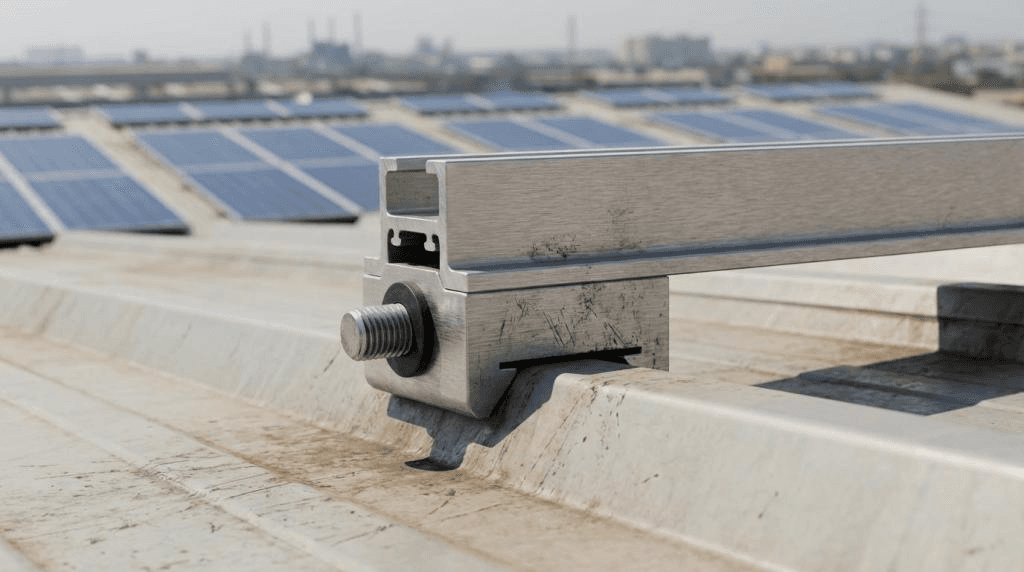
Roof waterproofing: Mounting method and penetrations need careful detailing to avoid leaks during monsoon.
Fire and electrical safety: Proper isolators, earthing, cable management, and protection coordination are essential.
A factory also needs an installation plan that respects production. Many projects, including those for rooftop solar for factories in India, are executed in sections, with work windows planned around dispatch schedules and high-movement zones.
What performance and maintenance look like over 25 years
Rooftop solar is often sold as “low maintenance,” which, alongside its energy efficiency, is true when compared to many industrial assets. Still, a factory should budget for routine cleaning and preventive checks, especially in dusty zones.
A practical O&M routine generally includes periodic module cleaning, torque checks, thermography or hotspot checks where required, inverter filter or fan maintenance, and inspection of cable trays and conduits. Remote monitoring helps your team detect issues early rather than waiting for the monthly bill to show a mismatch.
If your vendor offers long-term O&M with performance reporting, it is worth evaluating. Over decades, consistency beats peak-day numbers.
A simple evaluation checklist for factory owners and plant heads
Before you ask for final quotations, it helps to standardise what information you want and what decisions must be made internally.
Roof readiness: drawings, age, waterproofing history, structural capacity
Electrical data: 12 months bills, sanctioned load, single line diagram, DG details
Operations: shift timings, shutdown days, safety rules for working at height
Commercial: CAPEX vs OPEX preference, credit appetite, internal IRR target
Compliance: approvals responsibility, net metering path, commissioning timeline
This keeps discussions objective and prevents the project from becoming a price-only comparison.
Working with an EPC partner in Maharashtra: what “end-to-end” should include
For factories, execution quality is a financial variable. If a system underperforms by even a few percent due to design shortcuts, the lost units repeat every year.
An EPC partner should cover feasibility, engineering, procurement, approvals, installation, and long-term support. In Maharashtra, regulatory coordination and net metering paperwork are often where internal teams lose time, so a partner who routinely manages DISCOM processes reduces friction.
Solarising works with organisations on rooftop solar adoption with a lifecycle approach, from feasibility and savings assessment to approvals, installation, monitoring, and O&M. For factories that prefer low upfront outlay, Solarising also supports an OPEX model where you pay a pre-agreed per-unit rate for a fixed tenure, with O&M included.
A useful way to compare EPCs is to ask how they protect your generation and uptime, and maximize your return on investment, not only what they install.
Quality controls: documented test reports, commissioning checks, component certifications
Design approach: layout built around shading, roof constraints, and your load curve
Support model: monitoring access, response times, maintenance scope, spares plan
If you already have a target like “reduce bill by 30%” or “stabilise tariff exposure for 15 years,” share it early. It helps the system design match business intent.
Next steps if your factory is considering rooftop solar
Start with data, then move to design, then pricing. A good first step is a site visit with a bill and load review, followed by a generation estimate and a clear projection of self-consumption versus export under your DISCOM rules.
Once you have that, the rest becomes a controlled project: approvals, execution planning to avoid production disruption, and a maintenance plan that keeps your savings steady year after year.
Share on social media