Understanding Solar AMC Contracts in India
Choosing a Solar AMC Contract in India: A Complete Guide

Yash Jakhete
Co-Founder
Understanding Solar AMC Contracts in India
A rooftop solar plant is often approved on the strength of a payback calculation, which often takes into account the importance of an annual maintenance contract. The reality of that payback depends on what happens after commissioning, month after month, through monsoon, heat, dust, shutdowns, and expansion of loads.
That is where a Solar AMC (Annual Maintenance Contract) becomes a financial instrument, not just a service agreement. A well-written O&M contract protects generation, reduces downtime, keeps warranties intact, and makes sure your solar asset stays bankable across its 20 to 25-year life.
What “AMC” should mean for solar in India
In India, AMC is sometimes treated as “cleaning plus one visit”. That may work for a small residential system, but it is risky for commercial and industrial rooftops where a single inverter trip can quietly cut savings for days.
A good solar AMC should cover three layers:
Preventive maintenance to avoid failures and slow degradation
Corrective maintenance to restore generation quickly when something breaks
Operations support including monitoring, reporting, and coordination with OEMs, insurers, and the DISCOM when required
For Maharashtra sites, the AMC also needs to fit the on-ground reality: high humidity and wind in monsoon, dust and soot in industrial belts, and practical coordination around net metering, shutdown permissions, and site access.
Preventive maintenance: the part that preserves ROI
Preventive maintenance is where you “buy” reliability. It is scheduled, documented work, tied to an Annual Maintenance Plan. This plan should mention task frequency (monthly, quarterly, half-yearly, annual) and which checklists apply to your make and model of inverter, module mounting structure, AC distribution, and protection systems.
A preventive schedule should not be vague. It should list measurable activities, acceptance criteria, and records to be handed over after each visit.
Typical preventive items that should appear in an AMC include:
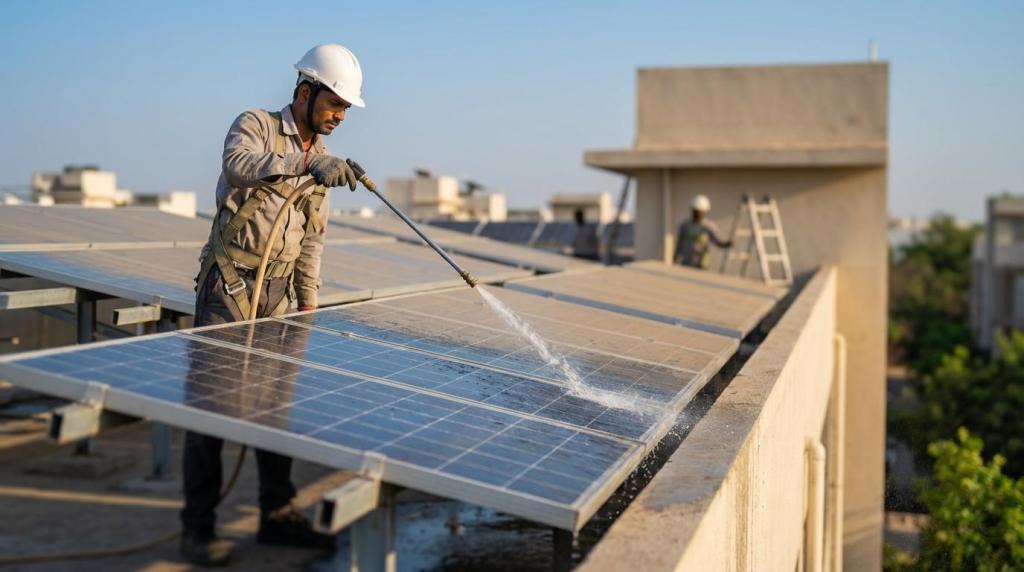
Module cleaning schedule
Visual checks for cracks, hotspots, burn marks
Torque checks on critical electrical and structural joints
Earthing and lightning protection inspection
DC and AC cable dressing, conduit checks, and UV damage review
Inverter health checks, event log review, firmware advisories
Testing of protection devices (SPD, MCB/MCCB, fuses) as applicable
Thermography and string-level electrical testing at defined frequency
After a paragraph like the above, ask your AMC provider to confirm if these are included as standard or treated as paid “add-ons”:
Cleaning and soiling management
Thermography (IR scanning)
String current checks
IV curve testing
Torque audit of structure and electrical terminations
Earthing pit watering and resistance recording (where applicable)
Vegetation and shade management
Hotspot and PID watchlist review
Corrective maintenance: response time matters more than promises
Corrective maintenance is about speed and discipline. When an inverter trips, a DC string goes down, or an SPD fails after a lightning event, the financial loss starts immediately. A good AMC defines the full chain:
Alarm acknowledgement
Remote diagnosis
Site visit dispatch
Temporary restoration (if needed)
Permanent fix with root-cause notes
Closure report with parts used and photos
This is where SLAs should be written in plain language. “We will attend quickly” is not an SLA. You want severity-based response and resolution times, plus an escalation route when the clock is breached.
In factories and warehouses, corrective work also needs coordination around production timings. Many repairs can be planned during low-generation hours, which reduces lost units.
Operations, monitoring, and reporting: your early warning system
Monitoring is not just a dashboard. It is the difference between noticing a 12 percent generation drop in two hours versus finding it in the monthly electricity bill.
Your AMC should specify what monitoring is included and who owns what:
Monitoring platform (OEM portal, third-party SCADA, data logger app)
Data availability expectations and what happens if the internet is down
Alarm rules (what triggers an alert, and to whom)
Ticketing system and evidence of closure
Reports should connect technical performance to business outcomes. A monthly report that only says “plant OK” is not useful. A practical annual maintenance contract (AMC) report usually includes energy generated versus expected, downtime summary, top alarms, cleaning impact, and a list of recommended actions.
A simple but effective requirement is to ask for “actionable reporting”: if generation is below expectation, the report must state the likely causes, what was done, and what remains pending.
What a “good AMC” includes, tier by tier
Many organisations in Maharashtra prefer AMC tiers because it helps match cost to risk. A small 50 kW rooftop on a stable roof may choose a lighter scope than a 500 kW solar plant with process-critical loads.
Here is a helpful way to compare typical AMC structures:
AMC element | Basic AMC (entry level) | Standard AMC (most common for SMEs) | Premium AMC (uptime-focused) |
|---|---|---|---|
Preventive visits | Limited, fixed schedule | Scheduled with documented checklists | Higher frequency plus condition-based triggers |
Cleaning | Often excluded or limited | Included with defined frequency | Included, optimised to soiling and season |
Remote monitoring | Basic view-only | Active monitoring with alarm response | Active monitoring with analytics and benchmarking |
Corrective support | Chargeable or limited | Included labour, parts extra | Included labour plus spares strategy and tighter SLAs |
Performance reporting | Minimal | Monthly performance and downtime report | Monthly plus quarterly review and improvement plan |
Warranty coordination | Limited | Included support with OEM claims | Included with proactive warranty compliance tracking |
What matters is not the label “Basic” or “Premium”. It is whether the scope and SLAs match the value of your lost generation if the plant goes down.
Contract clauses that protect you (and reduce disputes)
A solar AMC is long-term. Clarity reduces friction, and friction costs money. Strong contracts state what is included, what is excluded, how performance is measured, and how conflicts get resolved.
A practical set of clauses to insist on in an Indian AMC are:
Scope and exclusions: exact task list, frequency, and what counts as chargeable extra work
Response time SLA: acknowledgement time, site visit time, and resolution targets by fault category
Reporting format: monthly report contents, data source, and sharing method
Spares and replacements: which parts are stocked, who pays, and procurement timelines
Warranty compliance: documentation, processes, and who coordinates OEM warranty claims
Safety compliance: permits, PPE, working-at-height rules, lockout-tagout, incident reporting
Escalation matrix: named roles and timelines for unresolved issues
Termination and handover: exit process, documents to be handed over, and continuity support
Even a small rooftop system benefits from a written escalation matrix. When the plant stops saving money, you should not have to chase a generic helpline.
Spares strategy: the hidden reason plants stay down
A common reason for long downtime is not the fault itself, but the lack of spares and a clear replacement process.
Your AMC should state which spares are critical for your plant configuration and where they will be kept. For many rooftop systems, the high-impact items include:
DC fuses, SPD cartridges, connectors
Monitoring components (data logger, communication devices)
Inverter fans and filters (for relevant models)
A plan for inverter replacement timelines, including temporary restoration options
Also clarify who owns the spares. Some clients prefer owning spares stocked on-site, others prefer the AMC provider to manage spares with defined replenishment terms.
Warranty protection: AMC must not void your coverage
Solar equipment warranties sound long on paper, but they are conditional. OEMs may ask for proof of maintenance, installation compliance, and event logs.
A good AMC keeps warranties safe by:
Following OEM-prescribed maintenance steps
Logging visits, measurements, photos, and inverter events
Using authorised parts and proper torque values
Coordinating warranty claims with complete documentation
If your rooftop solar is net metered, also ensure any changes in configuration are documented properly, since electrical modifications can trigger safety and compliance requirements.
Safety and compliance: non-negotiable for rooftop sites
Rooftop solar maintenance involves DC voltage, AC panels, heights, and weather exposure. The AMC must define safety practices and accountability.
In Maharashtra, practical compliance also touches DISCOM coordination and site electrical discipline. The contract should clearly state who is responsible for permits, shutdown requests, and coordination with facility teams.
Ask your provider how they handle:
Work permits and site induction requirements
Lockout-tagout and arc-flash precautions on LT panels
Working at height systems (lifelines, anchoring, fall arrest)
Tools and testing equipment calibration
Incident reporting and corrective actions
One sentence that should appear in every AMC: safety requirements override speed targets, and the process for safe isolation must be documented.
Pricing models for solar AMC contracts in India
AMC pricing in India varies with solar plant size, rooftop complexity, travel distance, monitoring depth, and SLA commitments. The right way to evaluate cost is to compare AMC fees with the value of avoided downtime and preserved performance.
Common commercial structures include:
Fixed annual fee per kW, with defined scope
Fixed fee plus chargeable spares and major repairs
Hybrid models where incentives or penalties link to availability or response times
Also check escalation terms. A multi-year AMC should state how pricing changes year to year, and what triggers scope revision (system expansion, inverter replacement, adding batteries, changes in operating hours).
For businesses that choose an OPEX or PPA model for rooftop solar, clarify who signs the AMC and who is responsible for generation guarantees. Many OPEX structures bundle O&M into the per-unit tariff, which makes SLA clarity even more important.
AMC selection checklist for Maharashtra SMEs
A good AMC looks boring on paper because it is specific. It names tasks, timelines, and responsibilities.
Before you sign, ask for evidence that the provider can actually execute the contract across your district, not just sell it. Solarising, for example, typically positions O&M as lifecycle support with an ROI lens, handling execution and ongoing maintenance so businesses can keep savings predictable. The best providers also remain available after commissioning, since solar is a long-duration asset.
Use these questions in your AMC evaluation:
What are the exact preventive tasks and visit frequency for my system size and roof type?
What SLAs apply for inverter down, string down, and monitoring failure?
Will I get a ticket number for every incident and a closure report with photos?
Who coordinates OEM warranty claims and what documents will be maintained?
What is the spares approach and expected replacement timeline for critical parts?
How will you measure performance loss due to soiling, shading, or equipment issues?
Making the AMC work on the ground
Even a strong contract fails if site access is inconsistent. Decide internally who will coordinate with the O&M team, approve shutdowns, and share electricity bills or meter data needed for performance checks.
When the AMC provider, facility manager, and accounts team treat generation as a monthly KPI, solar stops being “installed equipment” and starts behaving like a stable cost-saving asset.
Share on social media