Understanding Commercial Net Metering in India: 2026 Guide
Discover the benefits of implementing commercial net metering in India to lower your energy costs and maintain a stable power supply.

Yash Jakhete
Co-Founder
Understanding Commercial Net Metering in India: 2026 Guide
Power bills for commercial and industrial connections in India rarely stay still. Tariffs move, fuel costs get passed through, and many facilities still pay a premium for reliable daytime energy. Rooftop solar changes that equation because it produces power when most businesses are running. Net metering is the policy mechanism that makes the numbers work on your electricity bill.
If you are evaluating C&I rooftop solar, it helps to treat net metering as a billing and approvals framework, not just a meter. Once you see how energy flows, how credits are calculated, and what your state DISCOM actually allows, you can size the plant correctly and protect ROI for the next 20 to 25 years.
What “commercial net metering” actually means
Net metering is an arrangement where a grid-connected rooftop solar plant is connected in parallel with your existing electricity supply. Your solar power is used inside the premises first. Only surplus, if any, goes out to the grid.
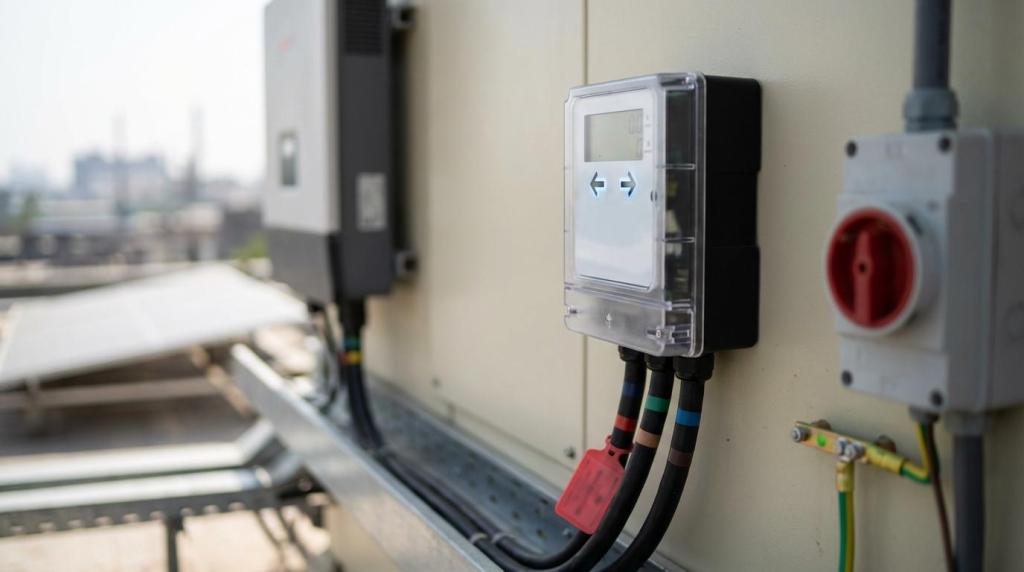
A bi-directional meter (import and export) records two directions of energy:
Import (kWh): units you draw from the DISCOM
Export (kWh): units your rooftop system pushes back when generation is higher than your instantaneous load
At billing time, the DISCOM applies the state’s net metering or net billing rules to settle these two registers.
The electricity flow in a C&I net-metered plant
The simplest way to visualise C&I solar is “load first, grid second”.
During the day, the inverter synchronises with the grid and supplies your internal loads. If your facility is consuming 200 kW and your solar is producing 150 kW, you import only the remaining 50 kW. If your facility is consuming 120 kW and solar is producing 150 kW, the extra 30 kW is exported and recorded by the meter.
Many commercial systems also have protection equipment (relays, isolators, earthing, surge protection) as per CEA connectivity requirements. Where the connection is HT, metering often uses CTs and PTs, but the logic stays the same: measure import and export accurately at the point of supply.
Sometimes you will hear about a separate “generation meter”. Some states or utilities ask for it to record total solar output for compliance or accounting. That meter does not decide your bill savings. Your bill is decided by the import and export readings used for settlement.
How settlement works on your monthly bill
Under pure net metering, export units typically offset import units on a one-to-one basis within the billing cycle, and many states allow banked credits to carry forward.
A simple example:
Monthly import: 50,000 kWh
Monthly export: 12,000 kWh
Net billed energy (conceptually): 38,000 kWh (plus fixed charges, demand charges, duties as applicable)
If export exceeds import in a month, the treatment depends on your state regulation. Common approaches include monthly carry-forward (banking), annual settlement, or a payout for the leftover at a pre-defined rate.
This is why plant sizing matters. Oversizing may look good in annual generation estimates, but exports are often valued lower than self-consumption in many state frameworks.
Net metering vs gross metering vs net billing (why the difference matters)
Many businesses assume “net metering” is universal. It is not. India’s central rules permit net metering up to 500 kW (or sanctioned load, whichever is lower), but your state SERC and DISCOM procedures decide the exact mechanism, caps, and settlement.
Here is the practical comparison you should use while evaluating proposals:
Mechanism | What you do with solar generation | Metering structure | Value of an exported unit | Typical C&I fit |
|---|---|---|---|---|
Net metering | Self-consume first, export surplus | Bi-directional meter (sometimes plus generation meter) | Often close to retail offset when adjusted as per state rules | Sites with strong daytime load and stable occupancy |
Gross metering | Export 100% of solar output, buy 100% consumption from grid | Two meters: generation export, and consumption import | Paid at a feed-in tariff decided by SERC (often lower than retail) | When required by regulation, or when exports are the primary objective |
Net billing (net feed-in) | Self-consume, export surplus | Bi-directional meter, import and export settled at different rates | Export paid at a defined rate, import charged at retail | Common where DISCOMs want to limit retail-level export credits |
The ROI difference can be significant because the best savings usually come from avoiding high retail tariffs through self-consumption.
Where policy ends and your state’s rules begin
India’s Electricity (Rights of Consumers) Rules and state net metering regulations work together. The centre sets broad direction, and states implement detailed procedures.
In day-to-day projects, the “state differences” that affect a commercial customer most are:
Capacity allowed relative to sanctioned load
Whether net metering is permitted for your consumer category and contract demand
Monthly vs annual banking, and when credits lapse
Whether open access consumers are restricted from net metering in that state
Metering and testing requirements (single bi-directional meter vs additional meters)
Fees, timelines, and inspection steps
This is why two factories with identical rooftops can see different project economics if they sit in different DISCOM jurisdictions.
When net metering delivers the best business case
The strongest results usually come when solar generation overlaps with your consumption profile.
Net metering tends to work well when you have:
Day-shift operations
High HVAC load (malls, hospitals, hotels)
Continuous auxiliary loads (compressed air, pumps, IT, lighting)
Stable tenancy (warehouses, campuses)
Predictable weekend vs weekday patterns
If your load is mostly night-time or highly seasonal, the design has to be more careful. Exports may rise, and the value of those units may drop depending on your state’s settlement method.
Design choices that decide ROI (more than module brand)
Commercial solar ROI is usually driven by how many solar units you consume behind the meter, and how reliably the plant performs over years.
A few high-impact decisions:
Right sizing vs rooftop max-out: A 300 kW roof may not justify a 300 kW plant if your minimum daytime load is 120 kW and export is poorly compensated.
Inverter configuration: Multiple inverters can improve redundancy and maintain output during partial issues, which matters for facilities that cannot afford long downtime.
Shadow analysis and structure choice: Even small shade events can reduce string output, so layout and row spacing matter as much as panel efficiency.
O&M and monitoring: A plant that underperforms by 7% to 10% year after year quietly erodes the entire payback model.
Financing model also changes the decision-making. CAPEX optimises lifetime savings. OPEX (pay per unit) prioritises immediate cashflow and predictable per-unit cost with limited operational burden on the facility team.
Approvals and documentation: what your DISCOM will ask for
Most delays in commercial net metering come from paperwork gaps, single-line diagram mismatches, and metering readiness at site. It pays to treat approvals as a project track, not a final step.
A typical application pack includes site, electrical, and compliance documents. Your EPC partner usually prepares these, but the consumer signature and existing connection details must be accurate.
Common items include the following.
Consumer details: latest bill, sanctioned load, contract demand, connection category
Technical drawings: single-line diagram, plant layout, interconnection point, protection scheme
Equipment compliance: inverter certificates, protection device specifications, meter compliance as per CEA/BIS norms
Undertakings and formats: DISCOM application forms, indemnity, net metering agreement formats
Site readiness: earthing details, panel room photos, space for meter replacement or additional meter box
After submission, DISCOMs generally conduct a site inspection, approve the interconnection, and then arrange meter installation and commissioning protocol. In many states, the bi-directional meter is installed by the utility at the consumer’s cost.
Commercial realities that can reduce savings if you ignore them
Some issues only show up after commissioning, when bills come in.
One is demand charges. Net metering offsets energy (kWh), but demand (kVA) charges and fixed charges may still apply. If your facility has high peak demand in late evening, solar will not reduce that peak unless operations shift or storage is added.
Another is export-heavy operation on holidays. Many factories run a lighter load on Sundays while solar generates well. If exports are settled at a lower rate, you may prefer a design that limits exports, or operational changes that pull some loads into daytime.
Also check your tariff category rules. Some states treat certain consumer categories differently for net metering, and open access customers may face restrictions.
A practical checklist before you sign off on plant capacity
The fastest way to avoid a poorly sized system is to validate three numbers early: sanctioned load, daytime base load, and rooftop constraints.
Ask for these to be clearly shown in the feasibility note:
Expected annual generation (kWh) with assumptions stated
Estimated self-consumption percentage in year one
Expected export percentage and how it is valued in your state’s settlement method
Payback range with and without performance degradation
Downtime and O&M assumptions
If a proposal looks “too good”, it is usually because export has been valued like self-consumption, or fixed and demand charges have been ignored.
How Solarising typically supports commercial net metering projects
For a business, rooftop solar is not only an engineering job. It is also a coordination job across the DISCOM, your facility electrical team, safety compliance, and ongoing performance tracking.
Solarising works as an EPC and lifecycle partner for C&I rooftop solar, with support across feasibility, design, approvals, installation, and operations. In practice, that usually means:
Feasibility that ties space, generation, and bill savings to your tariff and consumption pattern
Engineering and drawings that match DISCOM formats and CEA connectivity expectations
Support for net metering approvals, coordination for inspections, and meter installation readiness
Quality-focused execution, followed by monitoring and O&M so performance does not drift over time
Options for CAPEX and OPEX models, including financing routes where suitable, to protect cashflow and ROI
For many SMEs, the value is not only the plant build. It is the confidence that approvals, metering, and after-sales support will stay in place for a long-life asset.
Questions to ask your installer and internal team
Net metering policies change, but good project discipline stays the same. Before committing, ask questions that force clarity on settlement and long-term performance.
Start with these:
Which mechanism applies at my location today: net metering, gross metering, or net billing?
What is the allowed plant size relative to sanctioned load and contract demand?
Will there be one bi-directional meter or also a generation meter, and who supplies it?
How are banked units treated monthly and annually, and what happens to unused credits?
What performance monitoring will I get, and what is the response time if generation drops?
Clear answers here usually translate into a smoother approval cycle and a project that delivers the savings promised on day one, and year ten.
Share on social media