Understanding Commercial Electricity Bill Components in Maharashtra
Everything you need to know about commercial electricity bill

Yash Jakhete
Co-Founder
Understanding Commercial Electricity Bill Components in India
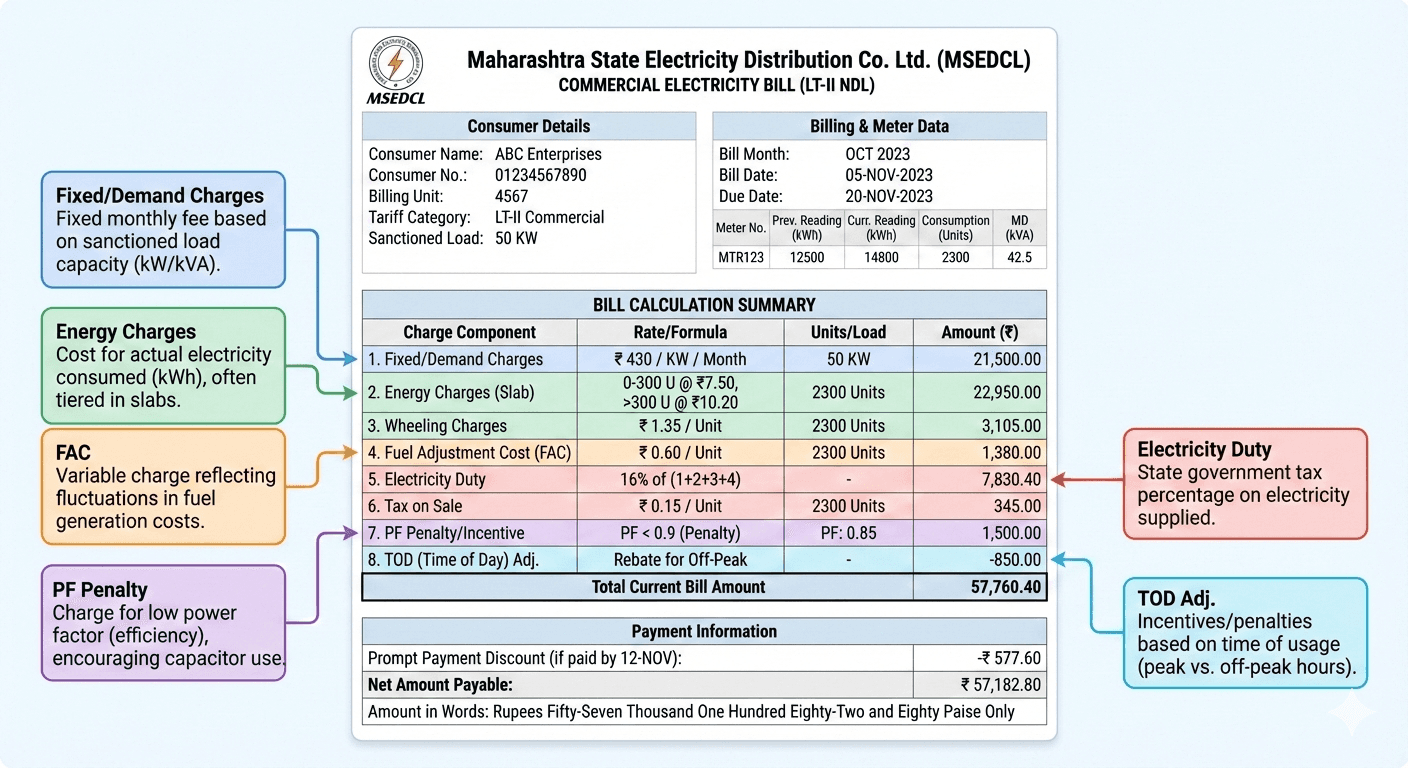
Commercial electricity bills in India list many items, but most of the cost comes from three factors: consumption (kWh), peak usage (kW or kVA), and timing (TOD slots). For businesses in Maharashtra, this clarity is important because tariff structures may include demand-based billing, power factor adjustments, and time-of-day multipliers that reward disciplined usage.
Why a “normal” commercial bill can vary so much month to month
Two businesses may record the same number of units yet pay very different amounts. The first reason is demand. When several loads (lift, air-conditioning, compressors, ovens, chillers, welding) start at the same time, the highest measured average over 15 minutes or a similar interval sets the billed demand for the month. One high spike can lead to a substantial demand charge and may trigger penalties if sanctioned demand is exceeded or if the power factor is poor.
The second reason is timing. Under TOD tariffs, energy used during peak periods carries a higher rate than energy consumed during off-peak hours, even if the total kWh remains unchanged.
The main components you should expect to see
The labels differ among DISCOMs and tariff types (LT vs HT, commercial vs industrial), but the logic remains the same. The table below can help explain your bill.
Bill component (common label) | How it is calculated | What typically increases it | What typically reduces it |
|---|---|---|---|
Fixed / Customer / Monthly charges | Set ₹ per month or per kW of connected load | Higher sanctioned load, extra meters | Changes only if load or tariff category is revised |
Demand charges (Billing Demand / Max Demand) | ₹ per kW or ₹ per kVA based on the highest measured demand in the billing cycle | Simultaneous equipment start-ups, seasonal HVAC peaks, process batching | Staggered start-ups, peak caps, energy storage, efficient controls |
Energy charges (kWh / Units) | ₹ per kWh, often according to usage slabs | More runtime, inefficient equipment | Efficiency improvements, operational discipline, rooftop solar |
TOD / TOD incentive or TOD charges | Extra ₹/kWh or percentage adjustment on units during peak/off-peak slots | Operating heavy loads in peak periods | Shifting load to off-peak times, using solar offset during daytime |
Power factor incentive/penalty | Bonus or fine based on the average power factor (common in HT) | Low power factor due to inductive loads | Installation of capacitor banks, APFC panels, proper motor sizing, VFD adjustments |
FAC / Fuel adjustment / PPAC | Variable charge set periodically | Fuel cost escalations, policy revisions | Not directly controllable; overall kWh reduction helps |
Electricity duty and other statutory charges | A percentage of selected bill amounts (state-specific) | Higher taxable energy consumption | Lower taxable energy usage mainly by reducing kWh |
Fixed charges: what you pay even if you shut the lights
Fixed charges (also known as customer charges, fixed/demand-based fixed, meter rent, or service charges) are unavoidable on a monthly basis. They cover the expense of reserving network capacity and servicing your connection, regardless of usage. For many small commercial users, this portion is modest, but larger connections or facilities with high connected load and low usage can suffer from high fixed costs. Reviewing whether your sanctioned load exceeds real operational needs may help save money over time, although reducing sanctioned load requires careful planning to avoid penalties or unintended tripping.
Demand charges: the “one bad quarter-hour” problem
Demand charges are based on the highest rate at which power is drawn rather than total energy consumed. Typically, the peak is measured as the highest 15-minute average. A facility may record high overall kWh usage and still incur a large bill if a specific interval sees many large loads running together. Several terms related to demand may appear on Indian bills:
Contract demand / sanctioned demand: The approved demand level for your connection.
Billing demand: The demand figure used by the DISCOM for billing (usually the recorded maximum demand or a minimum percentage of the contract demand).
kW vs kVA: Many HT tariffs bill on a kVA basis; a low power factor can raise billing demand even if actual kW remains steady.
Maximum demand (MD): The highest recorded demand level during the period.
If your bill is based on kVA demand, improving your power factor can lower demand charges without affecting production. This provides an immediate return on investment for inductive loads like motors, chillers, and compressors.
Energy charges (kWh): the familiar “per unit” part, with a twist
Energy charges multiply the total units consumed by the tariff rate, but many commercial tariffs use slabs where initial blocks of kWh are charged at one rate and subsequent blocks at a higher rate. This means that reducing a unit of consumption in a higher-priced slab saves more money than doing so in a lower-priced slab. The bill itself will show the slab breakdown and corresponding rates. Reducing kWh through measures like rooftop solar and energy efficiency upgrades typically shows the most visible impact from month to month.
TOD (Time-of-Day): the same unit can cost different amounts
TOD charges discourage energy use during peak hours while rewarding use during off-peak periods. Your bill details the units consumed in each TOD slot, along with any extra charges or rebates applied. A facility running steady loads may find TOD charges manageable, but batch processes during peak times can significantly add to the bill. A practical measure is to shift flexible loads (water pumping, pre-cooling, and heat processes that allow scheduling) into cheaper periods. Even a brief delay of 30 to 60 minutes can move a considerable volume of consumption out of the expensive peak slot.
The “other charges” that still matter
There are also several smaller items on the bill that, in sum, contribute to the overall cost. These include:
FAC or fuel adjustment charges
Wheeling or network-related charges, which are common with open access connections
Meter rent or meter service fees
Electricity duty and other levies imposed by the state
Reactive energy charges that apply to some categories
Delay payment charges, which are avoidable with timely payment
Although these items may seem minor individually, they often scale with the total kWh, so reducing energy consumption usually lowers these additional costs as well.
How to read your commercial bill in 10 minutes (and find the saving levers)
Begin by reviewing the total payable amount, then work backward to identify the main drivers:
Identify your tariff category and billing type (LT/HT, kW or kVA demand, TOD applicable).
Check fixed charges and note if they depend on connected load or contract demand.
Locate the maximum demand (kW or kVA) and the associated demand charge rate; determine the contribution of demand charges to your bill.
Review TOD slot data and identify heavy loads operating during peak periods.
Look for any penalties related to power factor, excess contract demand, or reactive energy.
Compare these factors over three to six months, as demand and TOD patterns become evident only through multiple bills.
What changes usually give the best ROI for businesses
Cost-saving strategies focus on reducing total kWh and lowering peak demand. Lowering kWh typically involves efficiency improvements and on-site generation, while lowering peaks requires better sequencing, controls, and sometimes storage. Although these strategies address different bill components, they often work together. High-impact actions commonly seen in offices, warehouses, and factories include:
Staggering start-up times for motors, compressors, and large HVAC units.
Implementing a peak cap approach during expensive TOD windows by briefly pausing non-critical loads.
Fixing compressed air leaks and adjusting compressor pressure setpoints.
Installing VFDs for fans and pumps where throttling is in use.
Maintaining capacitor banks or APFC panels and targeting an improved power factor in HT setups.
Switching to efficient lighting with occupancy-sensing controls.
Where rooftop solar fits into fixed, demand, and TOD charges
Rooftop solar effectively reduces the energy (kWh) component because every unit generated on-site cuts the need for grid consumption during solar hours under net metering or similar arrangements. Solar benefits include:
Lower daytime energy purchases, reducing overall energy charges.
A smaller impact from TOD multipliers when peak slots occur during daylight.
Reduction in charges that scale with kWh, such as FAC and some levies.
Solar does not affect fixed charges, which remain constant. It may also have limited impact on demand charges if the peak demand occurs after sunset. For facilities where peak demand drives costs, combining solar with load controls, process rescheduling, or battery storage can safeguard savings. Many businesses now treat these measures as part of an overall “bill engineering” project rather than considering system size alone.
A simple checklist before you act on your next bill
Take a recent bill and answer these questions in writing:
Which three items make up the largest share of my bill?
Is my billing demand close to my contract demand, or am I paying for unused capacity?
When did the maximum demand occur, and which loads were active at that time?
How many kWh were recorded in peak TOD, and which loads could be rescheduled?
If I add rooftop solar, will it lower my peak, leave it unchanged, or shift it to later in the day?
Answering these questions helps you move from merely reading the bill to actively managing your energy costs.
Share on social media