Solar Power in India: CAPEX & OPEX Explained
Capex vs opex solar India: compare rooftop solar CAPEX ownership vs OPEX/PPA, cashflow, risk, tax benefits and savings for businesses.

Yash Jakhete
Co-Founder
Solar Power in India: CAPEX & OPEX Explained
Electricity is one of those line items that keeps showing up on every monthly review, whether you run a factory in MIDC, a warehouse on the Pune belt, or a hospital campus in Nagpur. Rooftop solar is now a proven way to reduce that bill, but the first big decision is not the panel brand or inverter rating.
It is the commercial model you choose.
Most business rooftops in India adopt solar through one of two approaches: CAPEX (you buy and own the plant) or OPEX (you host the plant and buy power through a PPA). Both can deliver strong savings, but they behave very differently on cash flow, accounting, risk, approvals, and long-term value.
CAPEX and OPEX (PPA) in simple terms
In a CAPEX model, your business funds the project and owns the rooftop solar system from day one. You pay for engineering, procurement, construction, approvals, and commissioning, either through internal funds or a loan. After commissioning, the system offsets your grid purchase and you pay only for operations and maintenance (O&M) plus any residual grid import.
In an OPEX model (often called PPA or RESCO), a third-party developer invests in the system, owns it, and operates it on your roof. You buy the solar electricity generated at an agreed per-unit tariff for a fixed tenure. O&M is usually included. Many PPAs also specify what happens to the system at the end of the term, often a transfer to the customer at a pre-agreed value.
Both models rely on the same physical reality: rooftop area, structural strength, shadows, your daytime consumption pattern, and your local DISCOM rules for net metering or gross metering.
A quick comparison table for business decision-makers
Parameter | CAPEX (Asset ownership) | OPEX / PPA (Pay per unit) |
|---|---|---|
Upfront payment | High (project cost paid by customer) | Usually zero or minimal (sometimes a deposit) |
Ownership | Customer owns plant | Developer owns plant during PPA term |
Where it sits in accounts | Fixed asset, depreciation applies | Operating expense (power purchase) |
O&M responsibility | Customer (in-house or outsourced AMC) | Developer (generally included) |
Performance risk | Mostly on customer | Mostly on developer (subject to PPA clauses) |
Savings start | After commissioning, strong over time | From first bill, typically immediate |
Tax benefits | Possible accelerated depreciation and other benefits (as applicable) | Usually claimed by developer, not the consumer |
Tenure | Your asset life (typically 25+ years) | Contracted period (often 10 to 25 years) |
Flexibility if you move premises | Harder (asset relocation is complex) | Easier than CAPEX, but depends on contract terms |
This table is the summary, but the right choice usually comes from your cash cycle, tax profile, and risk preference.
How ROI looks different in CAPEX vs OPEX
With CAPEX, you accept a larger cash outflow upfront in exchange for lower energy cost for decades. Many Indian C&I rooftops see payback in the broad 3 to 5 year range, depending on tariff, system size, and onsite consumption. After payback, the plant keeps generating, and your “effective tariff” keeps dropping.
With OPEX, you avoid capital spend and you start saving from month one because the PPA tariff is structured below your prevailing grid tariff. Your savings are “spread out” rather than “front-loaded”, and your upside is capped by the contracted tariff structure.
A helpful way to think about it is:
CAPEX is a cost reduction investment.
OPEX is a cost reduction contract.
Both can be good business decisions. They just behave differently when budgets tighten, production fluctuates, or leadership wants predictability.
When CAPEX tends to fit better
CAPEX is generally preferred when you have the ability and intent to hold the asset for the long term, and when you want maximum lifetime savings.
After a paragraph like the one above, a quick checklist helps:
Best match: long-term roof control
Best match: healthy taxable profits
Best match: access to low-cost capital
Best match: strong internal maintenance culture
Best match: you want full upside of future savings
CAPEX becomes especially compelling when your site has high daytime consumption (so most solar is self-consumed) and you are confident the roof will remain available for 20+ years.
CAPEX realities businesses should plan for
CAPEX is not only about buying panels. It includes design quality, safety, approvals, and ongoing monitoring.
A practical CAPEX plan should account for items that often get underestimated:
Plant shutdown and access during installation (especially in running factories)
Roof waterproofing responsibility and coordination with civil teams
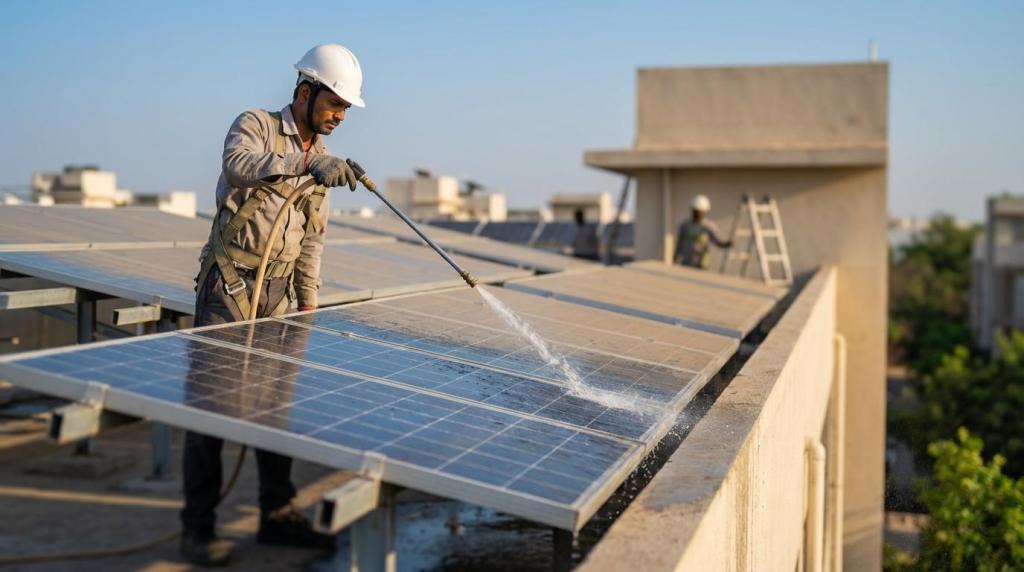
Scheduled module cleaning and water availability
Spares planning for inverter downtime
Data monitoring and response time when generation dips
If these are planned well, CAPEX can be a high-confidence investment rather than a maintenance burden.
When OPEX (PPA) tends to fit better
OPEX is generally preferred when you want savings with minimal upfront spend and you want to outsource performance responsibility. It is common among growing SMEs, multi-location businesses, and organisations that prefer predictable monthly costs.
OPEX often fits when:
you do not want to lock capital into a non-core asset,
your balance sheet strategy prefers operating expenses over adding assets,
you have limited in-house bandwidth to manage O&M,
you need fast approvals and execution handled end-to-end by a specialist.
For many businesses, OPEX is also a good “first solar project” model because it reduces decision anxiety around performance, spare parts, and warranty management.
What to check inside a PPA before signing
A PPA is not just a per-unit tariff. It is a long relationship, and it needs clean, readable clauses that match how your facility operates.
The most important checks are typically these:
Tariff structure: Fixed rate or escalation; how it compares with your grid tariff trend
Billing and metering: Meter location, data access, and dispute resolution process
Performance commitment: Minimum generation or availability definition, and what happens if it is not met
O&M scope: Cleaning frequency, breakdown response time, spares responsibility, inverter replacement approach
Exit and transfer: Buyout options, end-of-term transfer terms, and conditions if you sell the building
A well-structured PPA makes OPEX genuinely “hands off” for the consumer while still protecting the developer’s ability to maintain the plant properly.
Maharashtra specifics that affect both models
In Maharashtra, rooftop solar outcomes are tightly linked to local DISCOM processes and metering rules. Many projects depend on how net metering (or other approved metering arrangements) is processed, how quickly approvals move, and how your sanctioned load and transformer capacity align with the proposed solar capacity.
For businesses across MSEDCL areas and city utilities, practical factors that often decide success include:
clarity on export permission and metering configuration,
accuracy of single-line diagrams and protection systems,
timeline management for inspections and commissioning.
This is where experienced execution matters, because delays in approvals directly delay savings, whether you choose CAPEX or OPEX.
A decision framework you can use in one meeting
If you want a quick internal alignment between finance, operations, and leadership, use a scoring approach. Rate each statement as High, Medium, or Low for your site.
After a paragraph like that, the framework works well as a short list:
Capital priority: Do we prefer to spend capex for long-term savings, or preserve cash for core operations?
Tax appetite: Do we benefit meaningfully from depreciation and asset ownership, or is that upside limited for us?
Risk comfort: Are we comfortable owning performance responsibility, or do we want performance risk with a specialist?
Site certainty: Are we confident we will stay on this roof long enough to justify ownership?
Decision speed: Do we need day-one savings with minimal internal effort?
If most answers point to long-term stability and ownership appetite, CAPEX tends to win. If they point to cash preservation and outsourcing, OPEX is usually the smoother path.
Common sizing and savings mistakes (and how to avoid them)
Many rooftop solar disappointments are not model-related. They come from sizing and assumptions.
The typical avoidable issues are:
Oversizing beyond daytime self-consumption, leading to lower value export or blocked export
Ignoring seasonal production variability while forecasting monthly savings
Missing rooftop constraints like shadows from tanks, parapets, or adjacent structures
Treating “plant capacity” as the same thing as “bill reduction” without checking load profile
A proper feasibility study should map 15-minute load data (or at least hourly operational pattern), roof layout, and the applicable metering regulations before finalising CAPEX cost or PPA tariff.
Where Solarising fits in for CAPEX and OPEX projects
Many businesses do not need more information about solar. They need a clear, bankable plan and clean execution.
Solarising supports organisations in Maharashtra through the full rooftop solar lifecycle: feasibility and savings estimation, space and structural checks, system design, DISCOM approvals and net metering coordination, EPC execution, and ongoing performance support. Projects can be structured as CAPEX with ownership, or as OPEX where you pay per unit through a PPA with zero upfront investment and O&M included, based on site suitability and business preference.
A good partner should also be comfortable saying “no” to a project size or model if the roof, load profile, or approvals reality does not support the promised savings.
Practical next steps before you choose
Treat this as an investment decision, not a purchase decision.
Start with your last 12 months of electricity bills, sanctioned load details, and a simple note of operational hours. Add a roof walk to check shadows and usable area. With that, you can compare:
CAPEX: total project cost, expected annual generation, O&M plan, payback, and long-term effective tariff
OPEX: PPA tariff, escalation terms, estimated monthly savings, and contract protections
Once these are on one page, the choice between CAPEX and OPEX becomes far simpler, and far less risky.
Share on social media