Rooftop Solar Maintenance Strategies for Indian Homes
Rooftop solar O&M best practices India: optimise cleaning, track PR, do preventive checks, cut downtime and maximise kWh savings.

Yash Jakhete
Co-Founder
Rooftop Solar Maintenance Strategies for Indian Homes
Rooftop solar is often sold as “install once, save for 25 years”. In practice, the savings stay strong only when operations and maintenance (O&M) is treated like a routine business process, not an afterthought.
Indian rooftops are tough environments for PV modules and electrical equipment: dust, soot, salt air near the coast, bird droppings, long summers, and months of heavy rain. Good O&M keeps generation predictable, keeps net metering exports healthy, and reduces sudden repair bills.
What “good O&M” means for a rooftop solar plant
O&M is a mix of housekeeping, electrical discipline, data checks, and quick response. The goal is simple: maximise clean units (kWh) delivered safely, with minimum downtime.
It also protects warranties. Many module and inverter warranties expect evidence of basic maintenance, proper shutdown practices, and records of faults.
A practical O&M programme usually covers:
Site cleanliness and shading control
Performance monitoring and PR tracking
Preventive checks on inverters, AC/DC protections, earthing, and cabling
Faster fault response with spares planning
Documentation for auditors, insurers, and DISCOM-related requirements
Cleaning best practices: frequency, method, and water discipline
Cleaning is the most visible O&M activity, and in India it often has the highest immediate impact on generation. The “right” cleaning frequency depends on local dust load, nearby construction, road traffic, industrial soot, and bird activity.
One rooftop may need weekly cleaning in peak summer, while another may do well with twice a month. The right plan is the cheapest plan that keeps generation stable.
Cleaning decisions usually depend on these site conditions:
Highway-facing roofs
Cement and fly-ash zones
Coastal salt deposits
Dense bird movement
Nearby construction or material storage
Choosing the right cleaning frequency (India-specific)
A sensible approach is to set a baseline frequency, then adjust using data. If PR or specific yield drops without a clear electrical fault, soiling is a prime suspect.
Monsoon months can reduce the need for cleaning, but do not assume rain equals cleaning. Light rain can leave streaking, and mud spots can harden when the sun returns.
How to clean without damaging modules
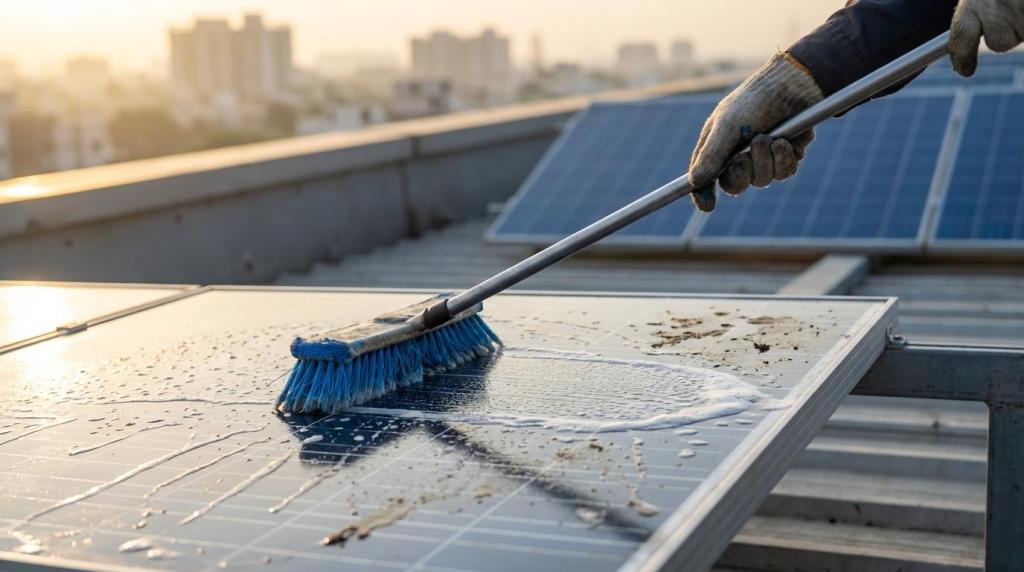
Avoid harsh scrubbing and uncontrolled pressure. Tempered glass is tough, but anti-reflective coatings and seals can be damaged by wrong tools and wrong timing.
Clean early morning or late evening, when modules are cooler. Hot glass plus cold water can cause thermal stress.
A good field method is simple: soft water where possible, soft brushes or microfiber tools, and trained staff who do not step on modules.
Water, safety, and rooftop realities
Water availability is a real constraint for many SMEs and institutions. A measured cleaning process can reduce water use without compromising output, especially when combined with scheduled dry brushing or air blowers in low-soil weeks.
Also check where the dirty water goes. Drain paths that wash over electrical conduits, junction boxes, or cable trays can create long-term corrosion.
Preventive maintenance schedule you can actually follow
The easiest way to keep O&M consistent is a calendar that is realistic for your team and rooftop access rules (factory shift timings, warehouse operations, school hours, etc.). The table below is a starting point that many Indian rooftop plants can adopt.
Frequency | Tasks | What “good” looks like |
|---|---|---|
Daily (remote) | Check inverter status, alarms, generation trend | No unexplained zero generation; alerts acted on same day |
Weekly | Visual walkdown, look for shading changes and hotspot signs | No broken clamps, no loose cables, no new shadows |
Fortnightly to Monthly | Module cleaning (as per site), check mounting fasteners | Stable yield; no wobbling structures; clamps tight |
Monthly | Review PR, compare strings/MPPTs, verify grid outages vs plant downtime | PR stable within expected seasonal band |
Quarterly | AC panel tightening, thermography (where feasible), earthing check | No hot terminals; earthing values within acceptable limits |
Half-yearly | SPD health check, insulation resistance (as per SOP), inverter fan/filter cleaning | Protection devices healthy; insulation readings steady |
Yearly | Full electrical audit, recalibrate meters if needed, structural inspection | Documentation complete; risks closed out |
One sentence that saves money: preventive tightening and thermography often cost less than one major inverter failure.
PR and performance monitoring: what to track and why it pays
PR (Performance Ratio) helps separate “weather effect” from “plant issue”. It compares actual AC energy output to what the plant should produce under the measured irradiation and expected system losses.
If you only look at kWh, you can miss problems during cloudy periods or seasonal changes. PR gives a cleaner view of plant health.
Track these metrics in a simple monthly dashboard:
Energy (kWh) and specific yield (kWh/kWp)
PR trend and variance from baseline
Inverter-wise generation comparison
Grid availability and outage hours
Alarm log count and repeat faults
When PR drops suddenly, treat it like a root-cause exercise, not a guessing game. A one-week delay can mean a full billing cycle of lost savings.
Common PR drop causes and the fastest checks:
Soiling or residue: Compare PR to last clean date; inspect streaking and bird droppings zones
String or MPPT underperformance: Compare inverter channels; look for one channel consistently low
Loose AC/DC terminations: Look for heating marks; use thermography during peak load hours
SPD or breaker issues: Check surge protector indicators and nuisance tripping history
Inverter derating: Review temperature alarms, fan status, and ventilation clearance
Setting alert thresholds that match Indian operating conditions
Avoid overly tight thresholds that create alert fatigue. Use practical triggers like:
PR drop beyond a set percentage compared to the last 30-day baseline
One inverter generating materially lower than peers on similar orientation
Repeated grid-fault alarms at the same time each day (can indicate voltage issues)
Any zero-generation event beyond a defined number of minutes during daylight
If your plant exports under net metering, also watch exported units. A persistent gap between expected export and actual export can point to meter issues, plant downtime, or operational schedule changes in the facility.
Downtime prevention: focus on the usual failure points
Most rooftop downtime in India comes from a small set of causes: inverter trips, AC breaker faults, SPD failure after lightning events, cable damage, and earthing problems.
The best downtime prevention strategy is to maintain “weak links” and keep spares that are hard to procure quickly.
Inverters: keep them cool, clean, and correctly configured
Inverters often derate because of heat, clogged filters, or poor airflow. Many are installed in utility rooms that become heat traps during summer.
Check:
Ventilation and clearance
Fan operation and filter cleanliness
Error history and repeat alarms
Firmware and grid code settings where applicable
If the site sees frequent grid voltage fluctuations, settings and protection coordination matter. Work with a qualified O&M partner to avoid nuisance tripping while staying within safety limits.
AC side: small issues become big losses
Loose lugs and ageing breakers can create heating, arcing, and trips. Quarterly torque checks and thermal scans are a strong habit for factories and warehouses where vibration is common.
Also verify that AC panels are protected from rain ingress, rodents, and unauthorised access.
DC side: insulation, connectors, and cable routing
DC faults can be intermittent and frustrating. Many issues come from poor connector crimping, UV-damaged cable ties, or cable rubbing at sharp edges.
A neat cable route, proper saddles, and periodic inspection reduce these faults sharply.
Lightning and surges: plan for the monsoon
Many parts of Maharashtra and coastal belts see heavy lightning activity. SPDs do their job and then quietly fail. If you do not check indicators, the next surge may hit the inverter or monitoring equipment.
Keep spare SPDs and fuses based on plant size and failure history, and replace with the right rating and make, not the closest available option.
Safety, compliance, and rooftop discipline
O&M is not only about energy. It is also about working at height, electrical safety, and documentation that stands up during audits or incidents.
Set clear shutdown and lockout-tagout steps. Train your staff and vendors on them. Make sure access to rooftops is controlled, especially in schools, hospitals, and multi-tenant buildings.
A practical site pack helps:
SOPs and checklists: Cleaning method, shutdown steps, emergency contacts
Single line diagram and labels: Clear panel labelling, string mapping, inverter IDs
Records: Cleaning log, fault log, maintenance actions, spares replaced
Permits and safety gear: Work-at-height permits, PPE checklist, insulated tools
Even a small 30 kW plant benefits from this discipline, because failures rarely happen at convenient times.
O&M models for Indian rooftops: in-house, AMC, and Opex plants
Your O&M setup should match your team capacity and the financial model of the plant.
In-house O&M
This can work when you have a dedicated electrical team, easy rooftop access, and internal process maturity. It still needs periodic specialist checks (thermography, insulation tests, inverter service).
AMC with an EPC/O&M provider
Most SMEs prefer an AMC because it brings routine visits, monitoring support, spares planning, and defined response times. It also makes budgeting easier.
Companies like Solarising typically support rooftops through full lifecycle services, including monitoring, preventive maintenance, and on-call breakdown support, which matters because solar is a long-term asset and the quality of after-sales support shows up year after year.
Opex / PPA rooftops (zero upfront investment models)
In Opex, the plant owner (developer) usually handles O&M because uptime affects their revenue per unit. As a consumer, you still benefit from reviewing monthly reports, PR trends, and downtime logs so savings remain consistent and disputes are avoided.
A simple monthly review that protects ROI
Once a month, spend 30 minutes on a structured review with your site team or O&M partner:
Check generation vs last month, note any unusual dips, and link them to cleaning dates, grid outages, or alarms.
Look at inverter-wise comparison and identify if one section is consistently weaker. Small underperformance often hides a string issue that will grow over time.
Confirm that preventive tasks happened on schedule and that spares used were recorded. If your rooftop runs under net metering, cross-check exported units with plant generation during high-export days.
When O&M becomes a routine rhythm, rooftop solar behaves like a dependable utility asset: predictable units, predictable savings, and fewer surprises during peak production months.
Share on social media