Rooftop Solar for Institutions and Campuses: Everything you need to know
Rooftop solar for institutions India cuts campus power bills, supports net metering, CAPEX/OPEX choices, and O&M planning for schools & hospitals.

Yash Jakhete
Co-Founder
Rooftop Solar for Institutions and Campuses: Everything you need to know
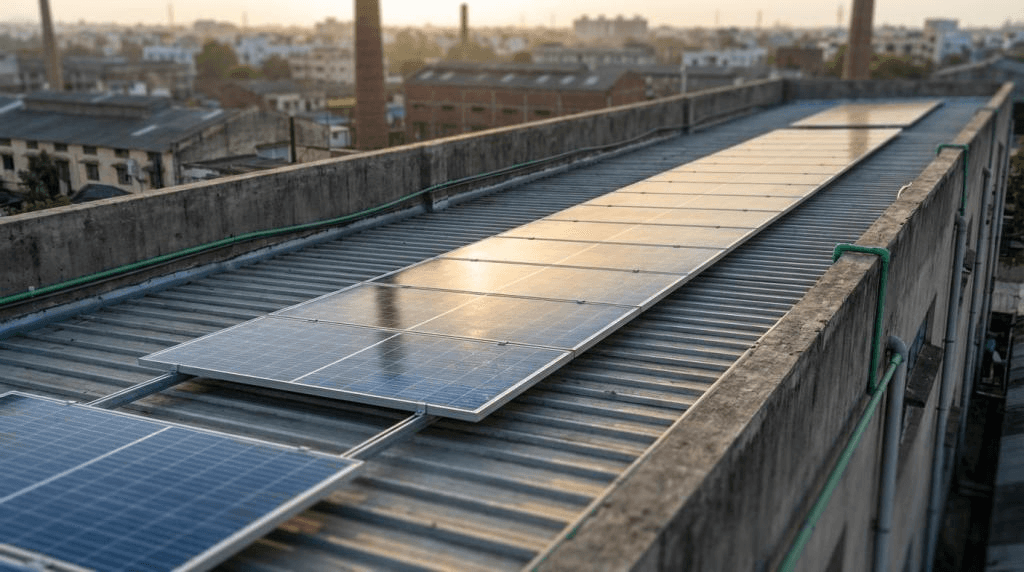
Institutions in India, schools, colleges, hospitals, research parks, training centres, and large multi-building campuses, have one thing in common: electricity is a recurring operating cost that rarely goes down. Rooftop solar turns idle terrace space, and even parking areas, into a long-term cost-control asset.
The best part is that many institutional loads are naturally “solar-friendly”. Classrooms, labs, admin blocks, libraries, kitchens, water pumps, and IT rooms draw power during the day, which is when solar generation is strongest.
Why campuses get strong value from rooftop solar
A campus is not a single meter and a single roof. It is a cluster of loads, roofs, and schedules. That complexity can feel like a hurdle, but it often increases the solar opportunity because generation can be distributed across many suitable surfaces.
Institutions also plan for decades, which matches the life of a solar plant. When you evaluate rooftop solar, think like a finance team and like a facilities team at the same time: savings must be real, and the system must be easy to operate safely.
After mapping the load profile and roof availability, most institutions see benefits in four buckets:
Lower daytime power purchase from the grid
Better predictability of energy spend for budgeting
Visible sustainability action that students, staff, and visitors can see
A live dataset for learning, audits, and ESG reporting
A smaller but important point is resilience. Solar without batteries will switch off during a grid outage for safety (anti-islanding). Yet solar can still support resilience planning when paired with UPS, batteries, or a backup system designed for critical loads like emergency lighting, server rooms, cold storage, and essential hospital equipment.
Feasibility first: what to check before you decide the plant size
A good feasibility study is not just a “kW you can fit” calculation. It is a check of technical fit, approvals readiness, and bill impact.
On campuses, the most common sizing mistake is installing the maximum possible capacity without checking export limits, sanctioned load, and tariff structure. Another common mistake is ignoring roof condition and ending up with rework during monsoons.
A practical feasibility exercise usually covers:
Load pattern: Monthly bills, maximum demand, and day vs night consumption
Space: Shadow-free area, roof layout, setbacks, and future construction plans
Electrical: Connection point, panel capacity, transformer headroom, and cable routes
Commercial: Current tariff, demand charges, and the share of bill that solar can offset
Quick reference table for planning discussions
Actual outputs depend on city, shading, tilt, and equipment selection, but these planning numbers help decision-makers get a first-cut view.
Plant size (kW) | Typical shadow-free area needed (sq ft) | Approx. annual generation (kWh) | Typical use-case on campus |
|---|---|---|---|
25 | 2,000 to 2,500 | 35,000 to 45,000 | Small school building, admin block |
100 | 8,000 to 10,000 | 1,40,000 to 1,70,000 | College block, hostel wing, small hospital |
500 | 40,000 to 55,000 | 7,00,000 to 8,50,000 | Multi-building campus, large institute |
1,000 (1 MW) | 80,000 to 1,10,000 | 14,00,000 to 17,00,000 | University, medical campus, industrial training institute |
Treat this table as a conversation starter, not a final design.
Design choices that matter on institutional rooftops
Institutions have constraints that commercial offices may not. Roof access needs to stay safe. Fire exits, staircases, and services like HVAC and plumbing must remain accessible. Many campuses also have older buildings where roof waterproofing and structural load capacity need careful checks.
You will usually choose between three deployment patterns:
Distributed rooftop solar across multiple buildings
A larger array on one or two strong rooftops with easier interconnection
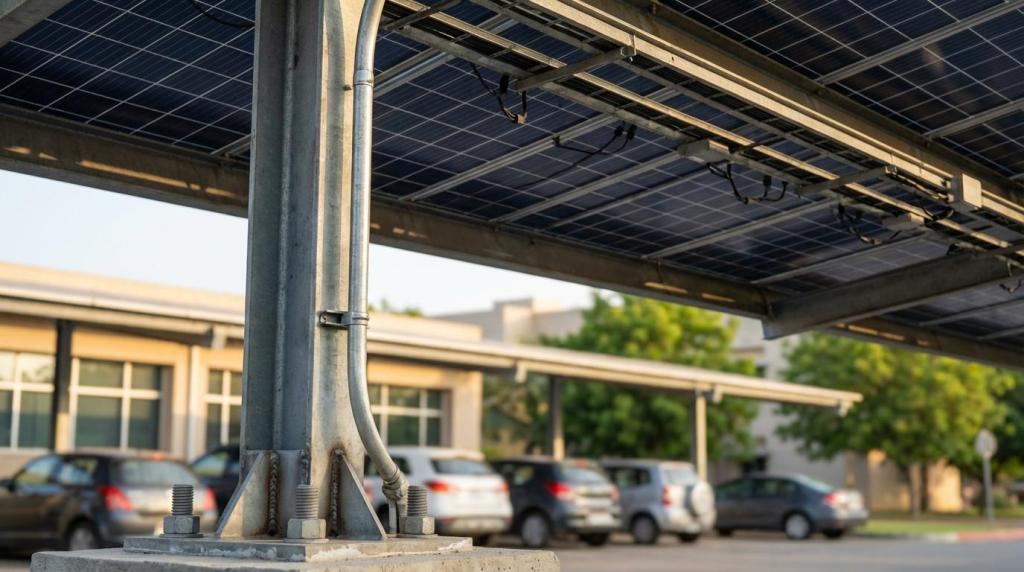
Parking canopy solar when rooftops are crowded or shaded
Parking canopies are worth attention for campuses because they create shaded parking and can reduce roof clutter. They can also simplify cleaning and maintenance access, though they require civil and structural planning.
Before freezing a design, align the project team on what “good” means. A campus solar plant should aim for reliable generation, safe operations, and easy fault isolation. These factors often matter more than squeezing in a few extra kW.
Here are quality signals that tend to pay back over the years:
String layout clarity: Clear labelling, logical grouping, and easy isolation for maintenance
Protection systems: Proper earthing, surge protection, and lightning protection integration
Access planning: Walkways, safe edge distances, and a defined maintenance route
Documentation discipline: As-built drawings, test reports, and warranty records stored centrally
Approvals, net metering, and what institutions should plan for in Maharashtra
Many institutions underestimate the time required for approvals and meter changes. In India, rooftop solar is not only an engineering project, it is also a coordination project with the local DISCOM and electrical inspectorate processes where applicable.
Net metering (or other settlement mechanisms) decides how exported units are treated and how the bill is adjusted. Even when you intend to self-consume most generation, the interconnection agreement and meter configuration must be right.
For Maharashtra sites, it helps to plan early for DISCOM-specific steps and timelines. The practical approach is to build the project schedule around approvals rather than treating them as a last-minute formality.
A useful internal checklist for institutions is to get these items ready before execution starts:
Sanctioned load and past bills: 12 months of bills, contract demand details, tariff category
Ownership and roof rights: Trust documents or campus authority letters, roof access permissions
Single-line diagram (SLD): Updated electrical SLD and proposed interconnection point
Structural note: Roof condition and load assessment summary for the intended buildings
This preparation reduces back-and-forth and helps avoid commissioning delays where the plant is ready but net meter integration is pending.
CAPEX vs RESCO (OPEX): which financing route fits an institution?
Institutions usually evaluate solar through two common models.
CAPEX means the institution pays upfront (or via a loan) and owns the plant. Savings are higher over the long term because there is no per-unit purchase from a third party, only minor O&M cost.
RESCO or OPEX (often structured as a PPA) means a third party invests, owns, and operates the plant, and the institution pays for the solar units consumed at a pre-agreed rate for a fixed tenure. Upfront spend can be close to zero, which is attractive for budget-constrained campuses.
The better model depends on cashflow priorities, procurement rules, and risk appetite. A few practical selection cues:
CAPEX fits when: you can deploy capital, want maximum savings, and can manage asset ownership
RESCO fits when: you want low upfront cost, prefer predictable per-unit pricing, and want O&M bundled
Also consider hybrid approaches. Some campuses do CAPEX on newer buildings with strong rooftops, and RESCO on canopies or expansion phases.
Don’t ignore funding sources outside the standard budget. Depending on the institution type, you may consider grants, alumni funds, CSR contributions, or green loans routed through approved channels. The key is to model savings conservatively and keep the repayment plan linked to actual bill reduction.
Getting ROI right: what affects savings the most
Solar ROI for institutions is largely driven by how much solar generation is used on-site and what tariff it offsets. If you offset higher-cost daytime consumption, payback improves. If export settlement is restrictive, oversizing can reduce returns.
The highest-impact inputs in an ROI model are usually:
Average per-unit energy charge (and expected tariff increase over time)
Demand charges and whether solar reduces daytime peaks
Shadow-free generation assumptions across seasons
O&M scope, cleaning frequency, and inverter replacement planning
Downtime risk and response time for service
One sentence that helps boards and principals make better decisions: solar is a 25-year asset, so a slightly higher spend on proven components and long-term service often produces better net savings than a cheaper installation.
Operations and maintenance on campuses: simple, but must be planned
Solar O&M is not complicated, but campus realities can create avoidable underperformance. Dust, leaf litter, nearby construction, and bird droppings can reduce output. Loose terminations or water ingress can create faults if inspections are irregular.
A campus-friendly O&M plan focuses on routine actions and quick visibility. Monitoring should be available to the facility team, not only to the vendor. Reports should be easy to read, monthly at minimum, with alerts for abnormal dips.
Common O&M practices that work well for institutions include scheduled cleaning aligned with local dust levels and monsoon patterns, quarterly electrical health checks, and annual thermography for early fault detection.
If your campus has student engineering clubs or an energy committee, it can be valuable to involve them in generation tracking and awareness boards. Keep safety and access control strict, and treat it as supervised learning, not informal maintenance.
Implementation planning that avoids campus disruption
Solar installation is construction work, and campuses are sensitive environments. The best projects treat safety, movement control, and scheduling as core scope.
Plan for exam seasons, admissions periods, and hostel occupancy. Decide where materials will be stored, how rooftops will be accessed, and how waste will be removed. A campus that communicates well internally sees fewer complaints and fewer last-minute stoppages.
A realistic timeline for an institutional project includes time for site survey, design freeze, approvals, procurement, installation, and commissioning. For multi-building campuses, phased commissioning often works better than waiting for every roof to be finished.
How an EPC partner typically supports institutional rooftop solar
Institutions often prefer an end-to-end approach because internal teams are busy running the campus. An experienced EPC partner usually covers feasibility, engineering, procurement, approvals support, execution, and ongoing service.
In Maharashtra, local process know-how around DISCOM applications and net metering workflows can save weeks. The same applies to coordination across multiple meters and buildings where roles and responsibilities need to be clear.
Solarising supports institutions with Maharashtra-specific rooftop solar execution, from feasibility and savings analysis to approvals, installation, monitoring, and long-term O&M. For campuses that prefer zero upfront investment, Solarising also offers an OPEX model where the institution pays a per-unit rate for a fixed tenure with O&M included.
If you are evaluating rooftop solar for a school, college, hospital, or multi-building campus, start with two numbers and one drawing: last 12 months of bills, the connected load details, and a basic roof layout. That is usually enough to run a first feasibility and move the decision from guesswork to a clear, ROI-backed plan.
Share on social media