Rooftop Solar and Diesel Offset: Designing Hybrid Systems with DG Sync
Diesel offset hybrid solar India: rooftop PV syncs with DG to cut fuel, prevent reverse power, and improve uptime with smart controls.

Yash Jakhete
Co-Founder
Rooftop Solar and Diesel Offset: Designing Hybrid Systems with DG Sync
Many Indian businesses run diesel generators (DGs) for outages, peak load, voltage issues, or simply because the grid is not dependable at the exact time production needs power. The problem is not only the fuel bill; leveraging diesel offset hybrid solar systems in India can address logistical issues as well. It is also logistics, downtime risk, noisy operations, frequent servicing, and the hidden cost of running a machine that was never meant to be the primary source of daytime energy.
A diesel offset hybrid solar system tackles this directly: rooftop solar supplies the load whenever sunlight is available, while the DG remains available for backup or support. The tricky part is making solar and DG work together on the same electrical bus without nuisance tripping, reverse power flow, or unstable frequency. That is where DG synchronisation (DG sync) design becomes the make-or-break factor.
Diesel offset is not the same as net metering solar
Rooftop solar for a grid-connected site is usually designed around net metering and monthly bill reduction. Diesel offset design starts with a different baseline: “How many DG units (kWh) can we replace safely, every day?”
That difference changes engineering decisions:
DG offset cares about second-by-second power balance (clouds, load steps, motor starts).
Net metering cares about monthly export, sanctioned load, and policy limits.
DG offset has strong ROI even without export, because diesel power is typically far more expensive than solar power per unit.
In many factories and institutions, the fastest savings come from cutting DG runtime in the sunlit hours when diesel would otherwise run continuously during long outages or poor supply quality.
What “DG sync” actually means in a rooftop solar hybrid
A DG produces its own voltage and frequency reference, typically 50 Hz in India. A grid-tied solar inverter is built to “follow” an existing reference. If the grid goes away and there is no stable reference, the inverter shuts down by design (anti-islanding protection).
In a hybrid PV-DG system during islanded operation, the DG often becomes the “grid” for the inverter. The inverter locks to the DG waveform using a phase-locked loop (PLL). Once synchronised, solar can inject real power into the same AC bus that feeds your loads.
Two inverter behaviours matter:
Grid-following inverters: These need a reference (utility or DG) and then synchronise to it.
Grid-forming capability (often via a battery inverter or microgrid controller): This can create a stable reference and manage fast transients, which helps reduce DG cycling and frequency swings.
Many practical Indian sites use an AC-coupled approach where the DG starts first, establishes the bus, and then PV inverters synchronise and begin supplying load. Advanced systems add a battery inverter that can “firm” solar output and even allow periods of diesel-off operation when conditions permit.
Common hybrid architectures for Indian commercial and industrial sites
The right architecture depends on how often the DG runs, how variable your load is, and whether you want true island operation or just peak shaving. The table below is a useful starting point during feasibility.
Architecture | Where PV connects | Best fit | Key advantages | Key watch-outs |
|---|---|---|---|---|
AC-coupled PV + DG (no battery) | PV inverter on AC bus with DG and loads | Sites where DG runs in daytime and load stays above a minimum | Simple retrofit, strong diesel offset ROI | Needs export prevention and PV curtailment logic to avoid reverse power |
AC-coupled PV + DG + battery inverter | PV on AC bus, battery inverter manages frequency and ramps | Frequent outages, fluctuating loads, need smoother transitions | Better stability, can reduce DG starts, can buffer clouds | Higher capex, careful SOC settings needed |
DC-coupled PV + battery + DG | PV charges battery on DC side, inverter feeds AC loads | Off-grid or microgrid style sites | High control over dispatch, efficient charging | More specialised design, retrofit can be complex |
Grid + rooftop solar + DG as backup (grid-tied with controls) | Standard rooftop PV with export limiters, DG only during outages | Grid present most of the time, DG for reliability | Lower complexity than full microgrid | During outage, PV may shut unless hybrid capability is included |
For many Maharashtra SMEs, an AC-coupled solution is a practical retrofit because it can integrate with existing DG panels, switchgear, and distribution with minimal disruption, provided controls and protections are designed properly.
The design goal: maximum solar use without “hurting” the DG
A diesel generator does not like running too lightly loaded. Low loading can cause wet stacking, poor combustion, and higher maintenance. It also does not like power flowing back into it. Your hybrid design must keep the DG inside safe operating limits while still pushing as much solar as possible.
A good design typically sets a minimum DG loading threshold (often discussed in the 30 percent range, depending on OEM guidance and site conditions) and then limits PV output to keep the DG above that minimum when the DG is online.
After a site study, the engineering team usually sets three core limits:
PV export to DG: Prevent reverse power flow into the alternator.
DG minimum kW: Maintain healthy operating load.
Ramp rates: Avoid fast swings that push frequency outside acceptable windows.
A simple way to think about sizing is: PV should be big enough to cover a meaningful portion of daytime load, but not so big that it constantly needs to be curtailed whenever the DG is on and loads are low.
Control modes you will see in real installations
Hybrid controllers and protection panels decide who supplies what, and when. They rely on metering, communication with inverters, and DG signals (run status, alarms, breaker position).
You usually want PV priority, but with predictable behaviour during clouds and load steps. After reviewing the single line diagram and operations, a control strategy is selected.
PV-first with DG support: PV supplies load first; DG supplies the remainder while staying above minimum load.
Peak shaving with DG: PV reduces DG kW during daytime runs, reducing fuel burn per hour.
Diesel-off windows (with battery): When battery SOC is healthy and PV is strong, DG can be stopped and the inverter forms the grid.
These modes sound simple. They are not, unless the control loop is well tuned and protection settings are coordinated across DG, inverters, and breakers.
Protections and interlocks that prevent expensive failures
In diesel offset hybrid solar systems in India, most “mystery trips” come from missing or poorly coordinated protection logic. The basics are well known, but they must be implemented with the site’s switchgear realities in mind.
Here are protections that commonly decide reliability:
Reverse power protection: Trips or curtails PV if power starts flowing into the DG.
Over and under frequency, over and under voltage: Prevents unstable island operation and protects sensitive equipment.
Anti-islanding behaviour: Ensures PV does not energise a dead bus unintentionally.
Synchronising and breaker interlocks: Ensures the DG breaker closes only under safe conditions and PV only runs when a valid reference exists.
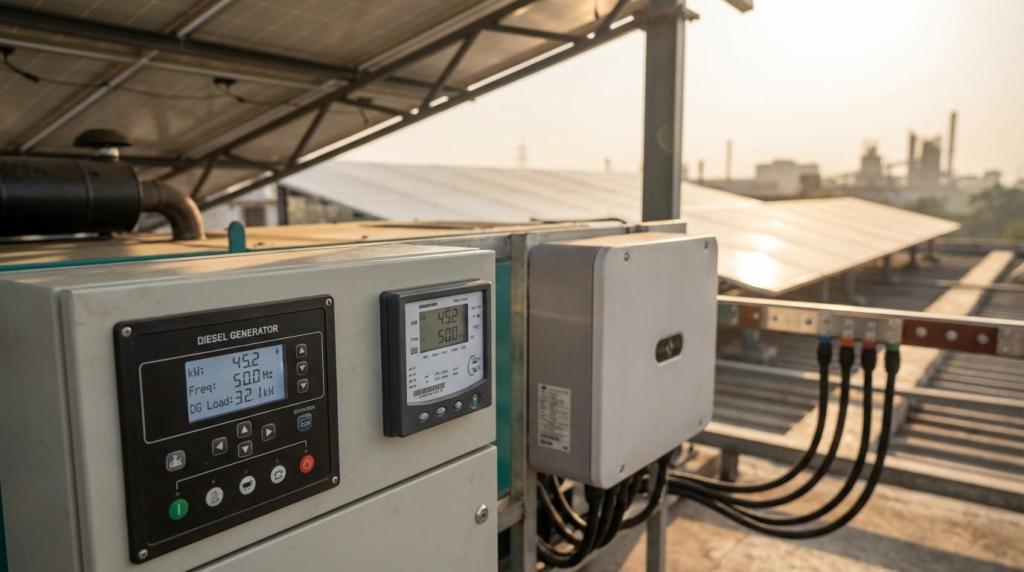
A well-engineered integration panel often includes metering on the main incomer, DG incomer, and the solar feeder so the controller sees real-time kW, kVA, voltage, and frequency, not guesses.
Communications: small detail, big operational impact
Many modern inverters and controllers can talk over Modbus (RTU/TCP). DG controllers often expose data over CAN bus or dry contacts. The benefit is not only a dashboard. It is better control.
With communications, you can do things like active PV curtailment based on DG load, schedule DG starts, and log diesel runtime against solar generation to quantify savings credibly.
Without communications, systems rely on “hard” trips. That works, but it often means more PV downtime and lower diesel offset.
A practical sizing approach for Maharashtra sites
Maharashtra facilities often face a mix of demand charges, time-of-day tariffs, and local distribution constraints. Some sites use DG not only for blackouts, but also to avoid production impact during voltage dips or feeder issues.
A sensible engineering workflow looks like this:
Measure 15-minute load data and identify the blocks where DG runs.
Audit DG: rated kVA, loading profile, fuel consumption curve if available, service history.
Check rooftop constraints: shadow-free area, structure, permissions, cable routes.
Decide the operating philosophy: grid-tied with DG backup, or true hybrid island capability.
Model solar generation against DG runtime to estimate displaced diesel units.
After that, PV is sized to match the most valuable hours, usually late morning to afternoon. Battery sizing, if included, is driven by the need to smooth clouds, reduce DG start-stops, or run critical loads during transitions, not by a desire to “store everything”.
Where ROI comes from, and where it quietly leaks
Diesel offset ROI is often strong because diesel power per kWh is high once you include fuel, transport, pilferage risk, maintenance, and the efficiency penalty at part load. Solar units during the day cost far less over the system life.
ROI leaks happen when the system is installed but cannot actually run at high PV output during DG operation due to poor controls, frequent trips, or a DG that is forced to run at unhealthy low load.
A quick commercial check during planning helps avoid that.
Fuel displacement potential: How many DG kWh can solar realistically replace during sun hours?
DG operating window: How many hours per month is the DG truly online, and at what average kW?
Curtailment risk: How often will PV be limited due to low load or reverse power constraints?
For some organisations, an OPEX or PPA structure can also make sense: you pay per unit for solar energy, with little or no upfront investment, and savings are visible from month one if the unit rate is below the blended cost of DG and grid power.
Commissioning and acceptance testing: do not skip this
Hybrid systems should not be signed off only on the basis of “solar is generating”. Acceptance tests should prove stable operation in the conditions you actually face.
Common site tests include:
Cloud simulation (rapid PV change) and frequency response observation.
Step load changes (starting a motor or switching a large load bank).
DG start with PV on, and PV start with DG on, verifying synchronisation sequence.
Verification of reverse power prevention at low load.
If you are procuring a hybrid system, insist on a commissioning report that records settings, test results, and as-built drawings. It reduces downtime later.
Monitoring, O&M, and why after-sales matters more in hybrids
DG offset hybrids combine two mission-critical assets: your generator and your power distribution. If the solar system trips repeatedly, staff will bypass it. If the DG gets damaged, the financial loss is far bigger than a few panels.
That is why long-term support and operations discipline are central to real savings.
A reliable O&M plan typically includes periodic checks for inverter alarms, breaker heating, CT polarity verification, firmware updates when needed, and trend tracking of DG hours versus solar kWh. It also includes basic solar upkeep: cleaning schedules suited to local dust conditions and inspection after monsoon winds.
Solarising, as an EPC focused on organisational rooftop solar in Maharashtra, typically approaches these projects end-to-end: feasibility and savings analysis, engineering, approvals where relevant, installation, commissioning, monitoring, and ongoing maintenance support. In diesel offset projects, that lifecycle view matters because the design must stay stable for years, not only pass a one-day trial run.
Questions to settle before you freeze the system design
The fastest way to avoid rework is to ask pointed questions early, while the single line diagram is still on the table.
DG health limits: What minimum loading will be enforced, and how is it measured in real time?
PV curtailment method: Will the system actively curtail via inverter setpoints, or rely on tripping?
Changeover philosophy: What happens when the grid returns, and how are transitions handled without nuisance shutdowns?
Clear answers here translate directly into higher diesel savings, fewer breakdown calls, and a hybrid plant that operators trust enough to keep switched on.
Share on social media