A Comparative Guide: Bifacial and Mono Panels for Indian Solar Projects
Bifacial vs mono panels India: choose bifacial for reflective, raised roofs; mono (TopCon/PERC) for standard roofs, heat and budget ROI.

Yash Jakhete
Co-Founder
A Comparative Guide: Bifacial and Mono Panels for Indian Solar Projects
Industrial rooftop solar power in India is rarely limited by sunlight. It is limited by roof constraints, operating temperature, soiling, approvals, and the need to hit a payback that makes sense for your CFO.
That is why the panel choice matters. A factory roof in Pune, a warehouse near Nashik, and a coastal plant near Mumbai can all have the same connected load, yet they can justify different module technologies once you account for heat, dust, roof colour, and net metering.
The three labels you will see on most quotes
Most industrial buyers compare quotes that mention one of these:
TopCon is an n-type cell technology, usually sold as high-wattage modules and often in glass-glass construction. Monocrystalline (PERC) is the older, widely used p-type technology. Bifacial means the module can generate from the front and the rear, and many bifacial modules use n-type cells (TopCon or similar) under the hood.
One sentence that saves time: bifacial is not a separate “cell type” in the same way as TopCon vs PERC; it is a module format that benefits from the surface beneath and the mounting height.
What industrial roofs in India do to solar performance
A module datasheet is measured in a lab at 25°C cell temperature, with clean glass and ideal irradiance. Your roof will not behave like that.
Heat is the biggest silent loss on Indian industrial roofs. Metal sheets and concrete decks push module temperatures high, and every extra degree reduces output. Dust and industrial pollution compound it by cutting irradiance and creating hot spots when soiling is uneven. Monsoon helps with cleaning in some locations, but it also brings long stretches of diffuse light.
Before you compare panel prices, compare these site realities.
Heat is the biggest silent loss on Indian industrial roofs. Metal sheets and concrete decks push module temperatures high, and every extra degree reduces output. Dust and industrial pollution compound it by cutting irradiance and creating hot spots when soiling is uneven. Monsoon helps with cleaning in some locations, but it also brings long stretches of diffuse light.
Before you compare panel prices, compare these site realities. After a quick roof walk and a shadow study, the “best” panel often becomes obvious.
Quick comparison table for industrial rooftops
The table below is a practical starting point for Maharashtra and similar climates. Actual results depend on layout, tilt, shading, and maintenance.
Parameter | Mono PERC (monofacial) | TopCon (monofacial, n-type) | Bifacial (often n-type) |
|---|---|---|---|
Typical strength | Lowest cost per watt | High energy per kW in heat, strong long-term stability | Extra generation when rear side receives reflected light |
Energy yield vs PERC | Baseline | Commonly ~5% higher in field conditions when compared at similar wattage classes | +0% to +25% depending on albedo, mounting height, tilt |
Heat behaviour | Weaker (higher temp coefficient) | Better (lower temp coefficient) | Depends on cell type; rear gain can offset some losses |
Early degradation (LID) | Higher | Very low | Very low if n-type; varies by brand |
Roof area needed for same annual kWh | Highest | Lower | Similar to TopCon on front, lower if rear gain is real |
Mounting complexity | Standard | Standard | Needs thoughtful clearance and surface reflectivity |
Weight (typical trend) | Lower | Often higher (many are glass-glass) | Often highest (mostly glass-glass) |
Best-fit roofs | Budget-first sites with adequate area | Space-constrained, hot roofs, long-life focus | White/reflective roofs, raised structures, high-albedo surroundings |
When TopCon earns its premium on Indian factory roofs
TopCon’s main advantage is simple: more kWh from the same roof area, with less drop in peak summer conditions. Independent trials have shown TopCon modules producing about 5 to 6% more energy than comparable mono PERC modules over extended periods, and that gap often looks better on hot roofs where temperature losses dominate.
This matters in two common Maharashtra scenarios.
First, when roof space is tight because of skylights, vents, fire clearance pathways, or future HVAC additions. Second, when your tariff is high during daytime production hours and every extra unit offsets expensive consumption.
A short paragraph that is still important: if your objective is to maximise annual units under net metering limits, TopCon can help you reach that cap with fewer modules, which can simplify layout and cabling.
After you shortlist TopCon, check whether the module is glass-glass, its mechanical load rating, and its actual weight. Industrial sheds can take substantial loads, but purlin spacing and wind uplift zones can still make heavier modules a design constraint.
Where monocrystalline PERC still makes business sense
PERC is not “bad”. It is proven, widely available, and usually the easiest to procure quickly across many wattage classes. If the project is cost-capped and the roof has enough area to meet your target kW, PERC can deliver acceptable ROI.
It also fits sites where your team wants a very standard bill of materials and straightforward replacement availability over time, especially if the plant is in a location where logistics are a recurring issue.
The trade-off is that PERC generally loses more output on very hot days and has higher light-induced degradation compared to n-type technologies. Over a 25-year asset life, those small annual differences add up to real money.
Bifacial panels: high upside, but only with the right roof physics
Bifacial modules can be a strong choice for industrial campuses because they can turn reflected light into additional kWh without needing extra land. On the right surface and mounting, bifacial gains of 10 to 25% over monofacial are seen in real projects.
But the rear side does not magically produce power on every roof. On a dark, dusty, low-clearance installation, the rear gain can be close to negligible. On many sheet roofs with low tilt (5 to 10 degrees) and tight mounting, bifacial behaves almost like a monofacial module, while still carrying higher cost and weight.
If you are considering bifacial, first answer the site questions, not the brochure questions. A quick checklist helps:
Roof colour and reflectivity: White-coated sheets, bright concrete, or planned high-albedo coating support rear-side production
Mounting height: More clearance typically means more rear irradiance and less shading from rails
Tilt and row spacing: Higher tilt and sensible spacing reduce self-shading on the rear side
Soiling and cleaning plan: Rear glass can also get dirty; plan safe access and frequency
Nearby surfaces: Bright parapets, service corridors, and reflective floors can add meaningful rear gain
A single sentence that can save capex: if you cannot create a reflective and well-spaced environment, price bifacial as a durability choice, not as a guaranteed yield booster.
Heat, humidity, and dust: the real battleground in India
For most factories, annual generation is decided by three months: peak summer, dusty shoulder months, and monsoon.
TopCon’s temperature advantage shows up in summer afternoons when module temperatures are highest. On those days, PERC’s output drops more sharply. Bifacial can recover some of that with rear-side contribution, but only if the rear side is “activated” by reflectivity and geometry.
In coastal and high-humidity belts, glass-glass construction (common in TopCon and bifacial) is valued because it reduces moisture ingress risk compared to typical backsheet constructions. Salt-laden air and high humidity do not automatically damage panels, but they raise the bar for quality of lamination, frames, earthing, and PID control.
Dust is non-negotiable. In heavy industrial zones, soiling losses can become large without cleaning. It affects every panel type, and it can flatten the expected yield advantage of premium modules if O&M is weak.
Roof structure and design: do not let modules drive unsafe choices
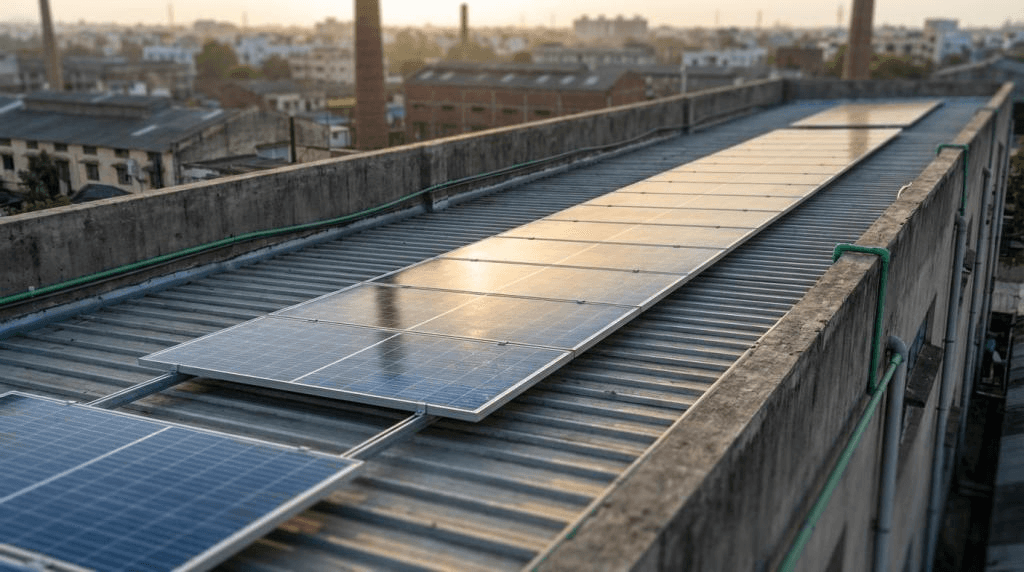
Industrial roofs vary widely: standing seam metal sheets, trapezoidal sheets on purlins, RCC terraces, pre-engineered buildings, and hybrid structures, making it essential to consider the placement and attachment of solar panels to effectively harness solar power. Before selecting a heavier module (many TopCon and most bifacial are heavier), confirm structural capacity, attachment method, and wind uplift zones.
Panel technology also affects layout choices:
PERC often pushes you to install a slightly larger DC capacity to reach the same annual kWh target.
TopCon helps you stay within roof area and keeps string counts lower for a given annual generation.
Bifacial may require higher tilt or more spacing to justify the premium, which can reduce how many kW you can physically place.
The best design is the one that meets energy targets without stressing the roof, while keeping maintenance safe, ensuring a positive return on investment. A plant that generates well but is difficult to clean or inspect will lose ROI year after year.
How net metering and approvals in Maharashtra influence the decision
In Maharashtra, many commercial and industrial rooftop systems are built around net metering or related grid-interactive frameworks, depending on the DISCOM area and applicable rules. That pushes buyers to size plants carefully around sanctioned load, transformer capacity, export limits, and consumption profile.
This is where higher-efficiency modules can help, but also where they can be unnecessary.
If your permitted export or net metering cap is the limiting factor, you may not need the highest-yield module, because you cannot export beyond the limit anyway. If your roof is the limiting factor, higher-yield modules can be worth paying for because they help you reach the allowed plant size or target annual units.
The smartest approach is to finalise the regulatory and electrical envelope first, then pick module technology that fits inside it with the best unit economics.
A practical selection framework that procurement teams can use
Most industrial rooftops can be mapped into three decision buckets based on constraints and expected gains.
After you review site photos and a basic feasibility note, use a simple rule set:
Best default for space-constrained roofs: TopCon monofacial
Best default for reflective, well-designed mounting environments: Bifacial (preferably n-type)
Best default for strict capex budgets with ample area: Mono PERC monofacial
And then pressure-test the choice with two-part questions that connect engineering to finance:
Cashflow model: CAPEX with accelerated depreciation vs OPEX/PPA with a per-unit rate
Risk tolerance: Proven availability and replacements vs newer tech with better yield
Operations plan: Cleaning frequency, access, shutdown windows, safety approvals
One sentence that is easy to miss: a module upgrade that adds 4% generation is only valuable if the plant is kept clean enough to realise that 4%.
How Solarising typically supports this decision for industrial buyers
Many organisations prefer a partner who can own the full lifecycle, because the hard parts are not only module selection. They are the feasibility numbers, roof checks, DISCOM coordination, net metering paperwork, and long-term performance tracking.
Solarising works as an EPC for rooftop solar in Maharashtra, with an ROI-first approach that connects energy modelling to site constraints, approval timelines, and O&M planning. Projects are usually evaluated with clear inputs like roof area, shading, structural notes, and consumption pattern, then designed around the best-fit solar panels technology, whether that ends up being PERC for lowest capex, TopCon for maximum kWh per square metre, or bifacial where rear gain is genuinely achievable.
Financing and OPEX options can also change the “best” panel choice, because what matters is the per-unit cost and the reliability of generation across decades, not only the module line item on day one.
Share on social media